89: Provence Part 2
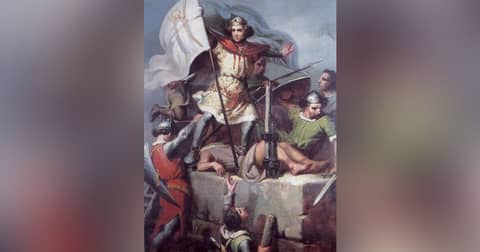


Provence suffers civil war, invasion and imperial intrigue but somehow still experiences a miniature golden age under the Counts of Barcelona.
Learn more about your ad choices. Visit megaphone.fm/adchoices
There’s no better way to learn history than to live it and no one does it better than Chase History Tours. Chase History Tours offers week-long tours for small groups of history lovers. From 5-11 October they are hosting a tour of Paris that highlights major sites from Revolutionary and Napoleonic France. Among their many knowledgeable tour guides is none other than William Clark, host of Grey History: The French Revolution and Napoleon. Unless you have a time machine there is no better way to relive the past than with Chase History Tours; and you are 100% more likely to keep your head or your money back! Go to ChaseHistoryTours.com now and take advantage of their 10% off sale until 15 April. Again that is ChaseHistoryTours.com, follow the link on our website and walk in Napoleon’s perfectly average-sized steps.
Chapter 2: Bricolage
“When the cat is away, the mice dance on the floor.”
-Provençal proverb
There is a beautiful word in French: ‘bricolage,’ which has no direct translation in English. It is often translated as ‘do-it-yourself,’ or ‘cobble together.’ A better translation of bricolage would probably be, ‘to make do with what’s available.’ No word could better describe the life of a Provençal peasant around the turn of the millennium. With a c’est la vie attitude, the Provençal life was a bricolage as peasants had to be self-reliant in virtually all aspects of life.
On paper, a peasant life did not seem so bad. Peasants might labor in fields for roughly 200 days of the year, leaving roughly 165 free for holidays and the off-season. Moreover, peasant life revolved around natural cycles. They rose with the sun, slept at night and might take rest and food during the heat of the day. Unlike modern humans confined to largely bureaucratic work in chairs, these daily physical exertions kept bodies lean and released natural feel-good chemicals.
Some contemporary writers have even claimed that peasants worked less than modern people in the developed world. Such writers would do well to read a history book. While peasants may have technically worked for themselves and their families during the harvest times, they were in constant motion throughout their lives. In this era, where consistent violence suppressed trade, peasants had to fashion and maintain most, if not all of their tools, clothes and lodging. Unlike in imperial Rome or our own modern society, most people did not have specialized jobs and had to learn how to do a little bit of everything. Even their entertainment was locally-sourced. The same farmers who worked almost every day, planting, cultivating, harvesting, building or sewing, had to spend what few free moments they had to ferment their own wine, learn to play crude instruments or fashion simple objects for ball games played between families or nearby villages. Furthermore, while working outside on a good day might be healthier than working in an office, thunderstorms, hailstorms, brush fires, earthquakes and other natural events were unavoidable risks to a peasant’s life.
As can be expected, the peasants’ greatest challenge, aside from disease, were the lords. Lords extracted heavy taxes on the peasants while paying none of their own. Simultaneously, they claimed ownership of important utilities such as mills, roads and bridges, all of which they charged fees for. Records show that local lords demanded the right of hospitality from peasants, forcing these poor people to hand over food and provide lodging for their ‘betters.’ Legally, only the Count could demand hospitality, but peasants did not know the law, and even if they did, there is no better legal argument than the end of a sword.
Life for the Provençal peasantry was a tableau of hardship and sorrow, punctuated by moments of joy. Healthy married women spent their entire lives in a state of pregnancy until menopause, giving birth to around eight live children, only half of which lived past the age of ten. Children lived carefree lives for a few short years before they too had to work with their parents. Without modern conveniences or a social security system, children were a parent’s retirement plan. When boys and girls grew up they had to care not just for themselves and their children, but for their parents as well, in a long cycle that connected people from birth to death.
Despite all of this, the peasantry of Provence performed a miracle. In the 11th-12th centuries, simply by living their lives they brought about a greater change to their society than the aristocracy or clergy. This is an incredible feat given that the aristocracy engaged in regular war and intrigue which eventually saw Provence come under the power of the House of Barcelona and in turn became tied to the Kingdom of Aragon. Meanwhile the clergy enacted the Gregorian Reforms, revolutionizing the functions of the Catholic Church. Yet, the peasantry take the gold: they remade the manorial system, bringing about an economic reconstruction of the south that laid a foundation for Provence’s entry into the Late Medieval Period.
The 9th and 10th centuries hit Provence hard. Raids by Vikings, Magyars and mudahim had depopulated much of the south. In their wake, Christian lords made sure to terrorize anyone the ‘pagans’ or ‘heathens’ had missed. Peasants fled to small towns that were so small they weren’t worth raiding, or congregated around rural castles for defense. In consequence, much of the most fertile land lay fallow. Those few farms the peasants cultivated were overpopulated as peasants sacrificed food and wealth for security. It was a strange and sad state of affairs that too many people lived on too little land when there was so much space theoretically available, but which could not be worked due to incessant warfare.
Over the next century a subtle change in language gives us a clue to a much wider phenomenon that overtook the Marquisate. At this time, lords designated Provençaux into three categories: manicipium, colonus, and accola. Manicipium meant those who owed labor to a lord, colonus meant those who had once been free but gave up freedom for protection, while accola meant a foreign colonus. What records remain show that in the 11th century a significant number of accola began settling in the previously violent parts of Provence.
The settling of immigrants was all part of a new understanding between the peasantry and landowners. First, the landowners recognized that they needed to appeal to peasants to get them to settle elsewhere. Thus, the nobles established an agreement known in Latin as medium vestum. Under medium vestum a peasant would cultivate land for a lord and in exchange receive an equal part of it. Whereas in earlier times most Europeans were serfs, forced to work entirely on land they did not own, now a small but growing number of peasants became independent landowners.
While relatively few peasants acquired their own land, all of Provence was becoming freer because of this new contractual system and France’s most important industry: wine. Provence has been a huge wine-growing region for millennia, and this era was no different. One of the problems with growing wine is that it takes multiple years for a new vineyard to produce its first grapes. No peasant can survive for years without a source of income, and so lords made yet another new deal. Instead of paying a fixed rent, or census, les Provençaux paid the tasca, a percentage of whatever the harvest turned out to be. Meanwhile, the peasant paid no taxes to the landlord in the years before the harvest.
As a result of these changes the entire landscape was changing, literally and figuratively. Whereas serfs had little interest in maximizing production if all their wealth went to greedy nobles who took everything from them in taxes, les Provençaux worked hard as they aspired to be independent landowners that could expect reasonable profits for their work.
Peasants did not passively accept these changes, but actively shaped how these took place. Not only did peasant demands result in these new agreements, they also reshaped their familial structure to accommodate this new economic system by opening their arms to immigrants. It may seem surprising to us that peasants would be so welcoming to strangers, yet if we understand the world they occupied it makes sense. In an era of subsistence farming, peasants did not want to marry off their daughters to another family, as they would lose one of their own. If farmers married their daughters to one family in exchange for a man from another, this would only result in an equal distribution of people. Yet, healthy adults from abroad with no family of their own offered to marry into a local peasant family. The immigrant, or accola in Latin, would be welcomed into the community, becoming a colonus. In exchange, the newcomer would add to a family’s strength. In this way, peasant families integrated immigrants, acquired new land and achieved a measure of independent wealth.
By the 11th century the records no longer classify the lower sort as municipum, colonus or accola as those terms became meaningless. More and more commoners became independent landowners or at least owed fewer obligations to lords than their ancestors had. Serfdom was declining in Provence as a market-based economy emerged, one that looked less like the Early Middle Ages and a lot more like the Late Medieval Period or even the early Renaissance.
It was during the 11th and 12th centuries that Provence experienced a period of remarkable growth due to relative peace and this freer economic system which encouraged entrepreneurship. In this endeavor, the clergy proved a great help. Since the church owned so much land they became major patrons of the peasantry, selling swamps for cultivation. If the peasantry appreciated the First Estate they hated the Second, as the aristocracy regularly abused them. While tensions were consistent between the Second and Third Estate up to the Revolution, there were at least some attempts to reform France’s warrior aristocracy into Christian soldiers.
Chapter 3: Noblesse Oblige
“When I have killed a brigand, I have saved the life of honest men, the death of one helping prevent his accomplices from making more evil.”
-Richard the Justiciar on his deathbed, after refusing a priest's pleas to repent of his life of violence
The Provençal aristocracy had won by the early 12th century. The Holy Roman Empire and the Kingdom of Burgundy were too busy dealing with other matters to meddle in the far south. The fracturing of the ruling house meant that no central Marquis could tell them what to do. Like teenagers when their parents are gone for the weekend, they lived with virtually no rules. Aristocrats bullied villagers for wealth, demanding payment for taxes and services they had no right to collect. When peasants refused to hand over their scant wealth to the aristocrats, the nobles showed just how noble they were and burned down their small towns. From their fortresses in the countryside the rural aristocracy also intimidated the urban-based bishops and merchant class, who they forbid from constructing their own castles.
The only major difficulty that the southern aristocracy had were other members of their own class, as the petty houses of Provence were in near-constant warfare against each other. Eras of chaos meant that the noble Provençal developed a significantly different system than those in the north. In northern France, the first, second, third and perhaps a few more sons, would inherit their father’s titles, depending on how great he was. Later sons were sent to the church, where they exercised both secular and religious power. In the south, houses chose the sword over the cross, employing all their sons as soldiers in their incessant conflicts. Only those houses with a prodigious number of surviving sons could afford to let them take the cloth as all hands were needed to fight the family’s many enemies.
Another major difference between the north and Provence was over inheritance practices. Northern lords divided their titles, lands and wealth among their sons. In contrast, the many petty lords of Provence feared that if they divided their meager holdings their neighbors could swallow up their estates piece by piece. This fear was ironically the fault of the Provençal aristocracy themselves. In the north, the French monarch and powerful dukes and counts regularly defended the lesser nobility from predatory lords as a means of halting the rise of new rivals and to garner the loyalty of the lesser nobility. By emasculating the Marquis, the Provençal aristocracy hamstrung the one power that would ensure order and balance in their region. As a result, the smaller houses could not afford to divide their property. Instead, primogeniture became more popular, as the eldest son inherited most, if not all of his father’s titles, land and wealth. Younger brothers then had to serve their elder as they had with their father, in a Roman-style patriarchy, wherein the pater familias, the head of a household, dominated.
As the patriarch’s power increased the law naturally shifted to patrilineal inheritance. While the great magnates in the north gave out large parcels of land as dowries, les Provençaux could not afford these. Daughter’s dowries shrunk and the lands given were largely ceremonial. As a result, women’s power declined dramatically, since they could not claim any significant lands in their own right and noble men did not compete for them as fervently as northerners. And they saw southern French are romantic!
Historians Noël Coulet and Martin Aurell provide a fascinating case study which demonstrates this phenomenon. There was in Provence a patriarch who divided his lands among his children. His eldest son received half of the family land and no doubt the best half. The younger son received a quarter. The daughter Oda received a quarter to use as a dowry. As a female, Oda received the smallest share her father had to give. Yet, at least she got something as subsequent generations of women received even less. Oda’s four daughters are said to receive very small dowries and their names are not even recorded in the records. With increasing frequency, chroniclers recorded when families had daughters but did not even bother to give them identities of their own. As a result, women’s prominence diminished in Provence and, unlike the north where there are numerous accounts of powerful and influential women, there are far fewer in this part of France.
It is probably not surprising that this region, which is so close to Italy would still emulate Roman customs. Another example of this is the practice of donation en précaire. Under this system a lord would give someone land for a long period of time in exchange for a small annual payment. This created a symbolic form of dependence as the receiver of land, the fidéle, had to offer payment to his lord.
A truly fascinating trend took shape in Provence during this time, concerning justice. Without a central power to monopolize the judicial system, rural lords consolidated power on their own lands. If the phrase ‘rural justice’ conjures images in your mind of backwardness, corruption and incompetence, you must realize how some things haven’t changed in a thousand years. When a legal dispute took place, lords were not non-partisan as they could directly enrich themselves by issuing fines to their lessers or punishing those who offended them. Trials were unprofessional as witness testimony was largely ignored and documents were often forgeries. To add insult to injury, most of the time people simply ignored the orders of the prescribing judge when the judgement went against them.
Another change in the legal system was that ordeals became more common. Ordeals were direct calls for divine intervention in deciding cases. These ordeals took many forms: an ordeal by fire could mean that an accused individual had to walk through a fire. If they were badly burned the onlookers determined that the person was guilty, whereas God would spare an innocent person. An ordeal by water was a similar test, whereby someone would plunge their hand into boiling water to see if they were badly scalded or not as a test of divine judgement. Of course, the most famous ordeal was a trial by combat, but since this could easily result in death it was not as common.
There is a strange story from the chronicles that tells us something about how justice worked in 11th century Provence. In this account, the viscounts of Marseille claimed that it was their duty to restore lands to the church, lands which once held a monastery that had been unlawfully destroyed by marauding nobles. The viscounts claimed to discover a charter proving that the land belonged to the monastery of Saint-Victor and not to the nobles who had incorporated it into their holdings. At first the noble family claimed that it was theirs by rights, at which point the lady of the land underwent an ordeal by water. When her arm came away badly scalded it showed that she had been lying and the viscounts ordered the family to turn over the land, which they later did not. You see, a long time ago wealthy people could usually get away with flagrantly breaking the law.
Monks from Saint-Victor then brought relics to the contested land as a sign of God’s presence and judgement. Some of the nobles squatting on the land repented and admitted they held no claim to it, though others still held out. At that point another ordeal was held. Since lie detectors hadn’t been invented yet, les Provençaux did the next best thing: they grabbed a child, tied him up and threw him in a pond. If the child sank, then the nobles must be telling the truth. However, if the child floated it meant that God favored the monks. Through the power of God and too much baby fat, the child floated. Now the nobles had no choice but to turn over the land.
On its surface, such trials imply that these people were superstitious and lacking clear legal rationale. That may be true, though in fairness to them, I think a lot of modern people aren’t much different. Beneath this layer of quackery we can see a measure of compromise and negotiation. The law then, much as it is today, is not necessarily a mechanism for determining what is right, but of reconciling two aggrieved parties and at times, drumming up enough popular support to convince the convicted party that they needed to make things right with the community. Thus, while the methods were questionable, in practice, court cases were a means of bringing two parties together in a non-violent way to settle a grievance without resorting to blood feuds.
For all of these reasons the Provençal aristocracy were a fascinating group of people who navigated a chaotic world of their own making. In the process they remade politics, gender relations and the law. If they were willing to change and adapt in some areas, one area that they had far more difficulty with was curtailing the excesses of their own behavior. For decades nobles in Provence could blame others for the chaos and bloodshed in their realms. They hired chroniclers who claimed that the depopulating of major areas was entirely the fault of the ‘Saracens,’ as all Muslims were called at the time. Before that, they blamed the Vikings and the Magyars. When those threats ended there was no one to blame but other members of their own class.
Not all nobles were ruthless killers. However, those that were could be incredibly cruel, burning down villages in their wroth, which effectively starved people to death. With the decline of the ruling house, rural lords went on a rampage, seizing and pillaging church territory even as they sought to violently exert their will over clerical affairs. The chronicles record that soldiers chased away the bishops of Apt and Sisteron so that they could not take their seat in their respective cathedrals. In 1074 one bishop was even killed by a knight for trying to assume his duties! Knights even sacked the priories of the venerable Cluny Abbey, the most important religious institution in medieval France. Symbolically, this should tell you everything you need to know about the nobility’s relationship to the church. Nobles claimed to defend the church and Christians from heathen invaders, with a particular mythology centered around the rescue of Bishop Maiolus of Cluny. However, when it suited them, they ravaged the land, turning France’s Garden of Eden into a battleground.
The regular acts of violence by the aristocracy multiplied with the fall of the ruling house of Provence. Without a powerful lord to keep order, the church responded with a vigorous campaign to reform soldiers’ conduct. Priests learned of the Peace of God movement developing in the duchy of Aquitaine and spread it within their own lands. The church further fashioned oaths and codes of conduct for soldiers. Churches created knighthood ceremonies as a way of turning the warrior aristocracy into Christian knights. When, in 1095, Pope Urban II announced the First Crusade at the Council of Clermont, Provençal clergy vehemently supported it as a means of giving purpose to the nobles of the land and also as a way of getting rid of these young men who were bored with swords: a terrible combination. It is no accident that the largest army of the holy war marched under the banner of Raymond IV, Count of Toulouse and Marquis of Provence. Thus, the regular abuses by the aristocracy against the clergy and the people led to major reform movements which transformed Provence and whose ripple effects spread across France and beyond.
Chapter 4: Quod Romanus pontifex unice catholicus dicatur
“I have loved righteousness and hated iniquity; therefore, I die in exile.” -Pope Gregory VII
The mid-11th century was a difficult time for the church in Provence. On the one hand, the clergy were far less impacted by the violence and chaos in the Marquisate as nobles still feared excommunication. However, church power was at a low point. Rural lords not only held secular power but they also dominated countryside churches where they appointed their chosen lords to occupy the holy sees. Meanwhile, powerful bishops centered around major cities such as Marseille and Arles managed to retain their rights against noble pressure. However, the rural aristocracy forbid cities from constructing their own castles, leaving them vulnerable to attack. While bishops ruled within their own cities the aristocracy curtailed their power beyond those meager holdings. It seemed clear at the time that the First Estate, that is ‘those who pray,’ was beholden to the Second Estate, ‘those who fight.’
Things began to change in the 1070s under the bold leadership of Pope Gregory VII. From nearby Italy, Gregory VII became one of the most important leaders of the Catholic Church in its history. He initiated a series of changes in church structure that are now known to history as The Gregorian Reforms. Gregory VII condemned secular interference in church affairs and aimed to ban the investiture of priests by aristocrats, control of church property by nobles, simony, which is the trading of offices within the clergy, and priestly marriage. This last one was important because marriages were political contracts: if a priest remained celibate then he would not be tempted to trade away power and lands to a noble; power and lands which Gregory VII claimed belonged not to that priest but to the church itself.
Before Gregroy VII the Catholic Church operated like a vast web of connections loosely held together by important institutions and the papacy itself. Gregory VII wanted to reinstate central authority and professionalize the church to prevent its abuse from without and corruption from within. Moreover, these reforms sought to significantly enhance the power of the papacy from a largely ceremonial position to the central power in the church and in Europe. Shortly after becoming His Holiness with the biggest hat, Gregory VII wrote the papal bull Dictatus papae, declaring that the pope held supreme authority on Earth and could even depose Emperors.
Holy Roman Emperor Heinrich IV ignored the pope’s declarations and installed his own man as Bishop of Milan in 1075. Gregory VII responded by excommunicating Heinrich IV, an act which gave his German vassals the excuse to revolt. Notably, Bertrand II, Marquis of Provence, sided with the pope as a means of further distancing his territory from the empire. As his power collapsed the beleaguered Emperor travelled to Canossa to beg for His Holiness’ forgiveness. There, Heinrich IV stripped to his undergarments and, barefoot in the snow, he pleaded for his immortal soul. The Road to Canossa has since become one of the most famous episodes in European history and a defining moment in medieval throne-and-altar politics. However, this was not a final victory for the church. The Investiture Controversy would drag on for another 45 years, until in 1122 Pope and Emperor signed the Concordant of Worms. Under this new agreement, the church gained the ability to select its own priests though they had to acknowledge the secular authority of the monarch.
These changes had a massive spillover effect across Europe. The Provençal clergy zealously supported the pope as he stood up against secular power with few exceptions. Aicard de Marseille, archbishop of Arles, and Brémond, abbot of Montmajour, opposed papal power, but they were both quickly forced out of their offices. The overwhelming majority of loyal clergy soon took action. They restored church chapters and asserted their independence from the nobility, who were none-too-happy about losing power over the altar. Bishops had limited success in the countryside, though they flourished in cities. Away from the rural aristocracy, bishops founded new monasteries and expanded their wealth and holdings. In the process, the clergy grew closer to urban merchants, known as the bourgeoisie, who used their wealth to patronize churches and raise bands of professional soldiers.
Provençal holy places reached a crescendo of activity, producing a distinct writing culture as never before. Scribes recorded stories of local saints such as Saint Isarn, who decades prior turned the monastery of Saint-Victor into the center of Christian learning in Provence. Under his tutelage, Provençal priests spread their influence abroad and achieved notable posts. A later abbot of Saint-Victor, Blessed Bernard, delivered the news to Heinrich IV that he had been excommunicated. The Emperor did not take the news well and had Bernard imprisoned, though the abbot eventually found his way back to freedom and southern sunshine. Later on, Bernard served as a legate in Spain. As a recognition of Bernard’s work, Pope Gregory VII made Saint-Victor an independent monastery. This eliminated all dues it owed to local bishops and made it subordinate solely to the pope.
Provence further benefitted from sparks of creativity from nearby Burgundy and slightly not as nearby Spain. In the Duchy of Burgundy, Cluny Abbey was rising to prominence, quickly becoming the greatest center of theological learning in all of Christendom. Cluny’s deep ties to Provence further invigorated the southern churches even as popes declared Provençal monasteries exempt from local hierarchies and placed them under the authority of Cluny. Meanwhile, a period of relative peace between Christians and Muslims took hold in Spain. From the Kingdom of Aragon, scholars and priests travelled across France, bringing with them gold from Al-Andalus. Many went to Saint-Victor which maintained important connections to the Catalonian monasteries of Ripoll, Cuixà, Sant-Joan des Abadesses and Sant-Miquel del Fai. Indeed, this was something of a heyday for Saint-Victor, which could claim 30 priories as dependents. Provence could give as well as it got, and its monks spread across Languedoc where they influenced Christianity across southern France.
The Gregorian Reforms radically changed the church in Provence. By its end, the churches were mostly independent of secular power. Their leadership derived mainly from lesser nobles rather than from the large houses, who lost the ability to fill the clergy’s ranks with their chosen men. Holy places produced more culture than perhaps at any time in their history. They spread their influence across southern France and played a huge role in developing the ideology of crusading even as they instituted the Peace of God movement. This professionalized church trained a litany of scholars who became the intellectuals and administrators of the Marquis’ court. In the process, the church massively built up the cities which became great centers of trade and learning.
This period saw the church become the most important power in Provence, replacing that of the rural nobility. Yet, the nobility still clung to what strength they had. These ever-troublesome aristocrats were only subdued with the help of a new generation of Catalonian lords.
Chapter 5: Between Barcelona and Toulouse
“Wise men learn by other men's mistakes, fools by their own.” -Provençal proverb
Politics and geography have been at war with each other since the first person drew a map. All other animals live, hunt and migrate in the lands best suited for them. In contrast, humans have long viewed themselves above nature. To many, geography is an inconvenience, whereas their fellows are the only real challenge.
Take out a map of medieval southern France and you will see Provence in the far southeast. In the middle south was the heartland of Occitania, which was then dominated by the County of Toulouse. To the southwest is the small territory of Gascony, whose north bordered the expansive Duchy of Aquitaine. Across the Pyrenees, along the northeastern Iberian coast lay the County of Barcelona.
Given the distance between Barcelona and Provence it is only natural to conclude that there was limited contact between them. And yet you would be wrong! These two counties came under the power of the House of Barcelona in 1112 and remained part of their domains for over a century. The House of Barcelona entered into Provence during a transformative period in its history and tipped the scales in favor of the changemakers against the entrenched order.
These new counts did not receive a warm welcome from everyone when they assumed power. The conservative aristocracy had grown used to having a weak overlord and resented a real power settling into the region, one who might actually uphold the law, rather than letting them do as they wished. Furthermore, the personal union of the two counties naturally worried the Counts of Toulouse who saw themselves sandwiched between a rival power. In consequence, the Catalans found themselves at war from within Provence and from without as the old nobility and the Toulousains sought to crush these foreigners.
The Catalans were proud and ready for a fight. They had been hardened by centuries of conflict with Muslims from Al-Andalus and wars against their fellow Christians in northern Spain. They held their own and then some. However, they could not win this conflict alone. The Counts of Barcelona and Provence had to create a whole new network of allies in southeastern France if they wanted to add it to their holdings. To accomplish their ends, the Counts of Barcelona struck an alliance with the bourgeoisie, the church and the new urban nobility. In the process the Catalans fundamentally remade Provence.
Our story begins with Raymond Berengar III [pronounced ‘ruh-MONE buh-rung-GEH’ in Catalan], which is how the Catalans pronounce the name, though in English it is written as Raymond Berengar III. Raymond Berengar III was the son of Ramon Berengar II. Not surprising, though what is surprising is that Raymond Berengar II had a twin brother named Berengar Raymond II. I swear, medieval lords didn’t even try. RB-II and BR-II divided the County of Barcelona, against their father’s wishes. One day, RB-II died in a mysterious accident that everyone assumed was an assassination by BR-II. BR-II was widely dubbed ‘The Fratricide’ and eventually forced to serve as regent for his dead brother’s son Raymond Berengar III. BR-II tried to redeem his image by warring against the famous El Cid and Muslims of Tarragona, for which he had much help from the Normans. These endeavors failed and he eventually left Barcelona to join the First Crusade with his half-brother, the Count of Toulouse, leader of the largest army in the holy war. After that, his fate is unknown.
With his murderous uncle gone, Raymond Berengar III ruled the wealthy and powerful County of Barcelona in his own right. Luckily for Raymond Berengar III, Barcelona was rapidly growing in size and power. After the Sack of 985, Barcelona was little more than a town, with around 1,500 people living amongst the burned out ruins of a once-great city. However, by the year 1,100 it had recovered and took its place among the most populous cities in Christian Iberia.
In 1112 Raymond Berengar III attained a claim to Provence. If you read the medieval chronicles you would know that he won Provence in a duel. The legends hold that the Holy Roman Empress Matilda was accused of adultery, which she countered by calling a trial by combat. Raymond Berengar III offered himself as her champion and won the fight, proving Matilda’s innocence. In gratitude, Matilda gave her handsome, Spanish knight the County of Provence. As great as this medieval tale is, it is far from reality. Sorry, historians tend to ruin everything. What really happened was that Raymond Berengar III married Douce, the Countess of Provence. Douce was in a vulnerable position at the time; the House of Provence had been weak for a long time, but by the early 12th century things had reached a crisis. Around 1110 a member of the rural aristocracy murdered her father. Without any male heirs to claim the Marquisate, Douce had to find a partner quickly, hopefully one with enough power to protect her and her family.
Raymond Berengar III and Douce’s marriage is a fascinating showcase of the changing politics in the Western Mediterranean. Barcelona’s connections to France are long and significant. During the period of the Frankish Empire, Barcelona was the key city within the Spanish March, a buffer zone that Charlemagne carved out to defend against attacks by Al-Andalus. Incorporation into the Frankish Empire meant that the Christian nobility of Barcelona could move within the Frankish social circles, intermarrying with other southern lords. In this way, the Catalans tied Frankish prospects to Iberia, aiding them in their perpetual fight against Muslims to the south and fellow Christians in the mountainous north. Raymond Berengar III likely saw his marriage alliance to Douce as a powerful opportunity to bring Provençal soldiers to aid in the Reconquista. If he did think that, he was mistaken. In fact, Provence was likely a drain on the County of Barcelona’s resources as the Counts used money and arms to subdue their new territory. While Provence caused the Catalans many headaches, their ultimate success in the Marquisate raised their profile and increased their power. For les Provençaux, it led to a radical recreation of their society.
When Raymond Berengar III took his place as the ruler of Provence the rural aristocracy almost immediately revolted but the new count was ready. He had brought with him a Catalan army and subdued his scattered vassals. A much more serious threat was the Count of Toulouse. The two sides warred from 1123 to 1125, with neither taking any significant advantage. In 1125 Toulouse and Barcelona partitioned Provence, with the House of Barcelona getting the lion’s share of the territory, but Toulouse received some valuable western stretches of land.
In 1131 Raymond Berengar III died and left his lands to his two sons, whose names you will never guess: Raymond Berengar IV and Berengar Raymond I. The elder brother received the County of Barcelona, while Berengar Raymond I took Provence. When Berengar Raymond I married the wealthy Béatrice, Countess of Melgueil, it revived tensions between the House of Barcelona and House of Toulouse, the latter of which was deeply upset that the Catalans looked like they were establishing themselves in southern France.
Anfos Jourdain (the Occitan name is pronounced Ahn-foos, zhoor-Dahn), the Count of Toulouse assembled a grand coalition to crush his Catalan enemies. The overwhelming majority of the rural nobility of Provence sided with him. Next, he cut a deal with the powerful Italian city-states of Genoa and Pisa, whose fleets could attack Provence’s coastal cities. Added to this was the powerful House of Baux, whose leader Raimond hated his brother-in-law, the Count of Barcelona, for taking Provence, which he viewed as rightfully his. The southern alliance appealed to the Holy Roman Emperor Conrad III, offering to recognize him as the overlord of Provence in exchange for his support. Conrad III leapt at the opportunity to expand his power over a territory that the empire had not ruled for over a century and he issued a golden bull which proclaimed Raimond de Baux as Provence’s rightful ruler. The empire only offered symbolic support, but this pretext was enough to convince many nobles in the region that their side would be victorious.
In 1144 the Baussenque Wars began when a Genoese fleet assaulted Melgueil and killed Berengar Raymond I. In one fell swoop, it appeared as if the House of Barcelona in Provence would fall to intrigue just like the last ruling house had. For the next few years the House of Baux assumed nominal leadership over the Marquisate even as Toulouse became the real power in the region.
Conquering a territory is easy; holding it is another matter, and soon the coalition’s leader faced problems within his own domain that forced him to divert his attentions inward. During this time radical preachers began crafting whole new ideas about religion, which would eventually coalesce into Catharism. Saint Bernard of Clairvaux criticized Anfos Jourdain for allowing heresy to spread in his lands. The church excommunicated the Count of Toulouse, forcing him to join the Second Crusade as penance. Anfos Jourdain died a year after leaving, possibly poisoned by his fellow Christians.
Toulouse’s money and arms were the backbone of the entire alliance and when its count left Provence was open for the taking. Raymond Berengar IV assembled a Catalan army and sailed to Tarascon. Recognizing he had an overwhelming force, the Provençal nobility abandoned the weak House of Baux and swore fealty to the Catalan conqueror. With hardly a fight, the Count of Barcelona put Raimond of Baux in chains and sent him to Barcelona where he died in prison.
The House of Baux was not ready to give up just yet, as it claimed the right to Provence through imperial backing and fought two more wars against the Catalans. Despite help from Toulouse, the House of Baux was defeated in 1156 and 1162. In that final year, Raymond Berengar IV razed Baux to the ground and secured the support of the Holy Roman Emperor Frederick Barbarossa through letters exchanged between their representatives. Tragically, as Raymond Berengar IV travelled to Turin to confirm his rights to Provence with the Emperor he fell ill and died.
The Count’s death opened up a new opportunity for the Count of Toulouse to again wage war on his eastern border. Raymond V of Toulouse…yeah, there are about as many Raymonds in the south as there Louises in the north and Guillaumes in Normandy…anyway, Raymond V of Toulouse divorced his wife Constance, sister of French King Louis VII. Told you there were a lot of Louises. This shocking dismissal of a royal wife tells a lot about how little power the Capetians exercised at this time in the south, as Raymond V put aside a princess of France to marry Richilde, widow of the former Count of Provence.
The Count of Toulouse now had a strong claim to the land, but the House of Barcelona had the bigger army, which is what really matters. The new scion of Barcelona, Alfonso II, was also King of Aragon, having inherited the realm from his mother. As glorious as the Count of Toulouse was, he was not a king, meaning his armories and coffers depleted much more quickly. The rest of the Western Mediterranean recognized Alfonso II’s dominance and the normally-rebellious House of Baux and the city-state of Genoa sided with him. On 18 April 1176 Alfonso II and Raymond V met on the isle of Jarnègues in the Rhône River, where the King of England and head of the Angevin Empire Henri II arbitrated the peace negotiations. The Count of Toulouse gave up any claims to Provence in exchange for the status quo antebellum and 1,000 silver marks.
A final war broke out in 1179 but this ended without any significant change. The Count of Toulouse continued the wars for some time but ultimately recognized he did not have the ability to oppose the Catalans on both sides of his realm, especially as he faced revolt within his own territory. Internal problems came to a head when the Third Lateran Council officially condemned the Cathar heresy and proclaimed that any lands they held were forfeit. This announcement led the viscounts of Nîmes and Béziers to turn against their count, fearing he would use the Catholic dictate as an excuse to seize their property. On-and-off fighting between Toulouse and Provence lasted until 1190, at which point the Catalans and the House of Toulouse made a lasting peace. The next time they went to war in any serious way was during the Albigensian Crusade when Southerners united against Northern invaders.
The House of Barcelona had triumphed in Provence. From their capital at Aix-en-Provence they ruled an area that stretched from the Rhône River in the west to the Alps in the east. While the new rulers and their retinue were almost all Catalans they sought to downplay any foreignness around them by embracing Provençal culture. They sponsored troubadours and artists and turned Aix into a celebration of Provence’s vibrancy.
The House of Barcelona was a rising power in the medieval period. However, they could not have won Provence unless they took advantage of a seismic change happening in the region. The Catalans appealed to the cities against the country and in the process brought Provence into a whole new era.
Chapter 6: The Time of Cities
“Troubled waters make for good fishing.”
-Provençal proverb
I imagine that for those of you who have no idea what happens next in our historical journey you must be on the edge of your seat every time there’s a noteworthy cliff-hanger. Will Julius Caesar defeat Ambiorix, Vercingetorix, Asterix and Obelix and conquer Gaul, or will they kill this upstart Roman? Will Napoleon win the Battle of Waterloo and turn Europe into a giant French Empire? Will Joan of Arc live a long and happy life once the war is over? If you are the sort of person that doesn’t know what’s coming next then this podcast must be thrilling.
For everyone else I imagine the joy you get from these stories is the depth I present them with. You may know the overall facts of what happened, but you didn’t know how they happened. Perhaps you knew that France and Germany developed from a split in the Carolingian Empire, but you didn’t know what caused the two territories to become their own entities and why one became French and the other German. Maybe you knew that the Crusades were a series of conflicts proclaimed by popes against Near Eastern Islamic countries, but you didn’t know that the origins of these conflicts came from French theologians who were inspired by Franco-Norman conquests of Islamic territories in Provence and across the Mediterranean.
When we read about history it is difficult not to think about where these events lead to. It’s hard not to think about the French National Assembly and read every speech by Robespierre and Danton as steps toward Napoleon’s empire. While it is true that much of the successes and failures of Revolutionary leaders gave Napoleon a space to seize power, Napoleon’s rise was never inevitable. In fact, if not for many instances of random happenstance it would never have happened.
Another example of reading inevitability into history would be studying the early rise of Adolf Hitler in 1930s Germany and seeing the Holocaust as the only possible result. It’s understandable for a person who reads Hitler’s description of Jews in Mein Kampf and listens to his speeches to assume that Auschwitz was the only possible end to this story. However, the Final Solution only came about in January 1942 at the Wannsee Conference, over two years after World War II began. Before that the German Foreign Office’s goal was to seize French Madagascar and deport all Jews to the island. This plan depended on Britain surrendering to Germany during Operation Sealion, at which point the Germans would gain access to the British merchant fleet, which they would use for the mass deportation of Jews. The victory of the Royal Air Force over the Luftwaffe in the skies of England is often lauded as one of the most heroic moments in British history. Yet, the success of the Tommys in aerial dogfights played a crucial role in ensuring the creation of the death camps. Without the use of the merchant fleet and with the British Royal Navy patrolling the seas, French Madagascar, which had never been a solid plan to begin with, was off the table.
There are definite long-term trends in history, the longue durée, as Fernand Braudel called them. However, there are also catalysts, as the subsequent Annalistes argued. History very often turns on the small, the unexpected, the seemingly random and personal choices of individuals. With this measure of nuance and understanding, let’s look at what happened in Provence and imagine what could have happened.
What I’m about to tell you is that Provence in the 11th and 12th centuries took gigantic steps away from the medieval period and towards something that resembled the waning days of medieval era, approaching the Renaissance. A defining feature of the medieval period was the retreat to the country. Without a coordinated system to supply cities with food from rural areas, the Roman imperial system collapsed. Cities also became major targets for raiders and invaders. Thus, the populace of the former empire fled to small towns, while the nobility enclosed themselves in castles. Cities still existed, but they were shadows of their former selves. Famously, Lyon would not reach its Roman-era population until the coming of the French Revolution, a millennia and a half later.
As the age of the Vikings, Magyars and Islamic mudahim ended, France became a relatively more stable place. Instead of foreign threats, major acts of violence were overwhelmingly committed by Christian nobles against their subjects and each other. France responded to this through the Peace of God and Truce of God movements, instilling a system of pacifism and Christian virtue that restrained the worst excesses of the nobility. As France became more peaceful the country could more adequately foster the growth of major urban areas.
Between the 11th and 12th centuries a conflict broiled throughout Provence between country and city. In the countryside were the old nobility, a class of people which had ruled Provence since the collapse of the Roman Empire. In the cities were professional soldiers, the rising bourgeoisie who hired them to defend their wealth, and powerful bishops who centered themselves in cities where they were more successful in bringing about reform and did not have to compete with the old nobility.
The old nobility held the advantage over the urbanites and their supporters, as they had since time immemorial. The agricultural produce in their villas was still more important than the merchant and manufacturing wealth of cities, as the vast majority of people still lived in the countryside. The rural aristocracy also maintained a measure of spiritual power, as they sponsored their own personal churches. This last point was one of the main reasons why bishops congregated in cities, as they wanted to escape the corrupting influence of the nobility.
The old aristocracy was in a strong position at this time. Yet, a whole new force entered Provence and tipped the scales in favor of the cities against the countryside: the House of Barcelona. After intermarrying with the House of Provence, the powerful counts of the House of Barcelona expended enormous resources to subdue their new territories. It was a long and difficult fight, given that they had to face an entrenched aristocracy that had successfully neutered the House of Provence and ruled the Marquisate. Furthermore, the House of Barcelona fought numerous wars against the Counts of Toulouse, who feared being sandwiched between Barcelona in the west and Provence in the east. After decades of warfare, the Counts of Barcelona succeeded in establishing their power over Provence. In the process they empowered the urban elite to a level of prominence that they had not experienced since the better days of the Roman Empire, roughly a millennia before.
If we were the type to read into the future we might say that during the 11th and 12th centuries Provence moved definitively towards the Renaissance, with its urban revival and move from a mostly agrarian economy to an increasingly trade and manufacturing society, with the accompanying growth in specialized jobs, which included city-based artists and scholars. However, I don’t think that’s what happened. I don’t think that Provence made small steps towards the Renaissance; I think what really happened is more exciting. Provence made incredible progress, far more than we might realize, and much of it was maintained even during a two century-long period of continual crisis.
Life in Southern France between the years 1209 and 1453 was not great. First, the North launched the Albigensian Crusade which killed up to a million people. Then, the Medieval Cooling Period meant cropland was less fertile, which in turn led to a European-wide catastrophe known as the Great Famine 1315-1317, which was so bad that some even turned to cannibalism. Lack of food meant that Europeans were significantly malnourished just in time for the bubonic plague to hit in 1347. Within a few years between a quarter to half of Europeans had died, with cities disproportionally affected.
Had Provence not experienced such horrific calamities, the region would have looked radically different. In an alternate timeline where these catastrophes did not happen and others did not take their place, could Provence and its Italian neighbors experience a flowering of urban-based art, science and political development much earlier? It’s impossible to say. What we can say is that history is not a direct line from one state to the next. History takes many twists and turns. I choose to believe that the major cities of Provence experienced a miniature golden age as they broke free from the domination of the countryside. These radical changes faced significant challenges during the European Era of Catastrophes, but enough lasting change had occurred that Provence was still poised to advance into a new era of European history. Proximity to Italy was not the only reason why Provence led the French Renaissance; fundamental change always has precursors and that is what we’re looking at now.
Between the end of the 10th century and the end of the 13th Provençal cities grew almost continuously, reincorporating some of their Gallo-Roman boundaries. Three groups stood at the center of the urban revival: bishops, bourgeoisie and professional soldiers. Bishops were not just religious figures but usually the political heads of cities. As such, they officially stood at the head of the power hierarchy. Bishops increasingly centered the operations of the church in major cities during the Gregorian Reforms because they wanted to break away from the domination of nobility who sought to influence church elections. Due to the immense wealth that they controlled, bishops were simultaneously the political leaders of cities and their most important patrons.
Beneath the bishops were the bourgeoisie. Today ‘bourgeoisie’ often conjures up images of Marxists in coffee shops complaining about capitalism, but the word itself originally had a much different meaning than the one it carries today. The word comes from ‘bourg,’ meaning ‘market town;’ thus the ‘bourgeoisie’ were simply people who lived in these market towns. As time passed, ‘bourgeoisie’ came to mean not just city-dwellers but those specifically involved in urban occupations. The commoners in the countryside were usually jacks of all trades, having to do all their own farming, hunting, and building for themselves and their family. Cities contained so many people that their inhabitants could perform specialized work. Instead of everyone having to learn rudimentary building, a city would have a builders guild whose employees’ entire job was construction. Yet, ‘bourgeoisie’ doesn’t usually refer to builders. ‘Bourgeoisie’ refers specifically to the most notable members of the bourg, the ones who were emblematic of any market town, that being those involved in finance: the bankers, the moneychangers and the financiers.
At this time the ‘bourgeoisie,’ the urban financiers, became a class all their own, one which sought to emulate the aristocracy in many ways. The bourgeoisie became incredibly wealthy through monopolies on trade or controlling large enterprises. In Provence, this would mean extraction of salt from the coasts. They became major patrons of the city, justifying their wealth through the granting of welfare to the poor and sponsoring churches. Finally, they hired soldiers to protect themselves and the city.
This brings us to the last group of people who defined the ‘new Provence’: the urban soldiers, or what came to be known as the ‘men-at-arms.’ One of the defining features of the medieval period was that the nobility held a monopoly on weapons and violence. You may recall way back when I was covering Charles the Bald that when a group of peasantry got fed up with Viking raids and began forming their own armed bands to counter them, the aristocracy slaughtered their own peasantry. Medieval nobles feared any challenge to their power and made sure to deprive peasants of weapons and the ability to defend themselves, even against mutual enemies, out of fear that the peasants would turn against their lords. However, there were always exceptions. At times, nobles needed to raise large armies and so they created militias, bands of adult men who could defend the lord’s territory. These men were semi-professional; they performed semi-regular drills to ensure they had basic fighting abilities. However, they were mostly peasants by trade and were in no way equal to the nobles.
As cities grew in 11th and 12th century Provence, the bourgeoisie began hiring healthy adult men to serve as professional soldiers. Free from other obligations, these men-at-arms could train until they were as equally skilled as the rural aristocracy. The rise of men-at-arms significantly challenged the existing social order, which was based on personal feudal ties. Instead of owing service to lords because they were vassals, men-at-arms owed service to whoever was paying them. The old nobles often viewed the men-at-arms with disdain, as slovenly mercenaries without honor or Christian principle. Yet, they served as valuable instruments of a more capital-based society, where wealthy merchants could command as large a force as a lord.
The bishop and the bourgeoisie formed a power-sharing agreement through the creation of a whole new type of government: the consulate. The consulate was an Italian import. At this time many independent city-states were forming in northern Italy. Merchant families came together to form an elected body that represented their class of wealthy elites. Taking a cue from their eastern neighbors, Avignon became the first major city to form a consulate in 1129, followed by Arles in 1131. In this system a bishop and corulers managed the city alongside 8 or 12 consuls. Beneath them were the notaries and judges. The main body of the city was the parlement which elected a council of 120 members and who in turn elected the 8 to 12 consuls.
This system was not wholly democratic as only the wealthy could vote, and even then it was the bishops who held real power. However, the consulate presented a major change in medieval government. Rudimentary democracy took hold. Palatial city offices became the meeting halls for communal leaders, replacing the noble castle or episcopal cathedral. Civic pride became widespread even among those who were exempted from the halls of power. Cities began adopting emblems. Arles had a lion, Avignon had the gyrfalcon and Marseille had Saint-Victor killing a dragon. These symbols were important because now cities had the pageantry that the aristocracy displayed on their heraldic devices except now everyone could sport these symbols. While a noble house’s banner might inspire them and their vassals, a city’s flag, symbols and colors could inspire all of its inhabitants, much as how today a sports club’s insignia brings people together.
When the Counts of Barcelona arrived in Provence they quickly recognized that the bishops and bourgeoisie could be their best allies against the continually rebellious nobility. The Counts granted charters to communes, using local governments as a counter to the rural aristocracy’s power. Furthermore, they also allowed cities to build castles so they were no longer vulnerable. Catalan soldiers, supplemented by men-at-arms defended roads from highwaymen. Counts also sponsored the construction of roads and bridges so that they could control tolls and trade routes. Bishops provided spiritual authority to the House of Barcelona’s actions. The counts could also use the excuse that they were defending churches to punish recalcitrant aristocrats. In all of these ways the new powers of Provence allied against the old, inaugurating a novel order based around wealthy cities.
At the heart of Provence was the city of Aix, which replaced Arles as the capital in the 1180s. Initially, Arles dominated the south due to its large population of roughly 15,000 citizens. However, Arles was too independent for the Count’s tastes, having formed into a merchant republic within the county. The breaking point came when the Holy Roman Emperor Frederick Barbarossa chose Arles as the site of his coronation in 1178, as an attempt to reassert imperial authority in the south. Thus, the Counts of Barcelona shifted to Aix, a relatively large city which was located almost dead-center in Provence’s heart. There the count established a court of troubadours from Occitania and Provence, minstrels from Catalonia and scholars from northern Italy. In this way the court at Aix blended Mediterranean cultures even as it promoted a unique Provençal identity.
Epilogue:
This people has lofty eyes, a ferocious spirit, is prompt to take up arms, more profligate than others but more slothful in gathering wealth. The Provençals are as different from [the Franks] in their customs, their will, their manner of worship and their food as a hen is to a duck. They are frugal in their manner of life, more careful in investigating matters and more apt to work hard. But, that I not hide the truth, they are less warlike. They reject ornamentation of the body, which they say is a vile thing and is to be left to women. But they take pains in the ornamentation of their horses and mules. Their zeal in this time of hunger aided them more than many peoples who were more eager to fight. When there was a dearth of bread, they endured, content with roots. They did not spurn husks and they took up long iron tools with which they found grain in the bowels of the earth. Thus, boys still sing that ‘Franks go to war and Provençals to food.’
-The Gesta Tancredi
France’s sunny south experienced a tumultuous and fruitful period after the reconquest of Fraxinetum. At one point, the leaders of Provence dreamed of being great kings and came close to accomplishing their goals; however, that dream was too large. Unlike the densely-populated Île-de-France, this region did not contain a massive city like Paris. Provence was simultaneously too small to be a major kingdom and too large to be easily controlled without a metropolis to hold it together. Provence was Provence, nothing more or less. The Bosonids tried to force it to be something greater than it was, leading to one of their leader being blinded and the other abandoning it entirely.
During the 12th century the House of Barcelona seized control of Provence, bringing with them a host of Catalan nobles and artists. However, the Counts of Barcelona recognized that they had to rule with the locals, not over them. The Catalans sided with the bishops and bourgeoisie to form a new ruling clique against the rural aristocracy. In effect they pushed Provence towards something novel, something which in some ways resembled the early Renaissance more than the medieval period.
While the House of Barcelona settled the political question it did not rule absolutely and not without controversy. One major fault-line that remained in the south was over politics. Tensions flared as the bourgeoisie wanted more authority and viewed the church as their major competitor for power over urban spaces. In 1150 there was an anticlerical uprising in Arles. In 1156 common people attacked churches and granaries owned by the church. Religious disagreements caused an even larger rift than political ones. As time progressed Catholic bishops called for brutal repression of Catharism, even as it grew increasingly popular in the south. By 1200 the relationship between church and consulate degenerated into open conflict across almost all Provençal cities.
Provence’s flowering between the years 978 and 1209 is often forgotten. The Albigensian Crusade saw northern lords crush the south. Cities were burned, industries destroyed, churches razed and hundreds of thousands were killed. Such violence meant serious declines in southern identity and culture. Yet, hopefully we can look back and recognize that Provence was not a backwater region waiting for Paris, Lyon or some other noteworthy place to lead it forward into a new era. On the contrary, Provence in the year 1200 was developing a complex political scene with consular republics, early industries and a thriving local culture. Provence’s limited impact on its neighbors was not because its people were not creative or ingenious, but because they lacked the power to impose themselves on others or to resist invaders from outside. Medieval Provence was thus the flower of France, trampled upon its blooming.
Special thanks to Bry Jensen of Pontifacts Podcast for reading the quotes. Pontifacts podcast is a pod that covers and ranks all of the popes in history. Go check them out!
Sources:
Irene Barbiera, Maria Castiglioni and Gianpiero Dalla-Zuanna, “Demography, Peasantry, and Family in Early Medieval Provence, 813–814,” Population (English Edition, 2002-), Vol. 77, No. 2 (2022), pp. 249-274.
Constance B. Bouchard, “The Bosonids or Rising to Power in the Late Carolingian Age,” French Historical Studies, Vol. 15, No. 3 (Spring, 1988), pp. 407-431.
Noël Coulet and Martin Aurell, La Provence au Moyen Âge (Le temps de l’histoire), 2024.
Encyclopedia Britannica
The Gesta Tancredi
John Howe, “The Nobility's Reform of the Medieval Church,” The American Historical Review, Vol. 93, No. 2 (Apr., 1988), pp. 317-339.
Jessika Nowak, “Imperial Aspirations in Provence and Burgundy,” Transcultural Approaches to the Concept of Imperial Rule in the Middle Ages, 2017, pp. 139-156 .
Tomàs de Montagut, Barcelona, a Society and its Law: 11th-13th Centuries, Catalan Historical Review (2008), 35-46.
Stephen Weinberger, “Cours judiciaires, justice et responsabilité sociale dans la Provence médiévale : IX e -XI e siècle,” Revue Historique, T. 267, Fasc. 2 (542) (AVRIL-JUIN 1982), pp. 273-288.
Stephen Weinberger, “Peasant Households in Provence: ca. 800-1100,” Speculum, Vol. 48, No. 2 (Apr., 1973), pp. 247-257.
Stephen Weinberger, Jean-François Sené, “La transformation de la société paysanne en Provence médiévale,” Annales. Histoire, Sciences Sociales, 45e Année, No. 1 (Jan. - Feb., 1990), pp. 3-1.