92: Countesses and Queens
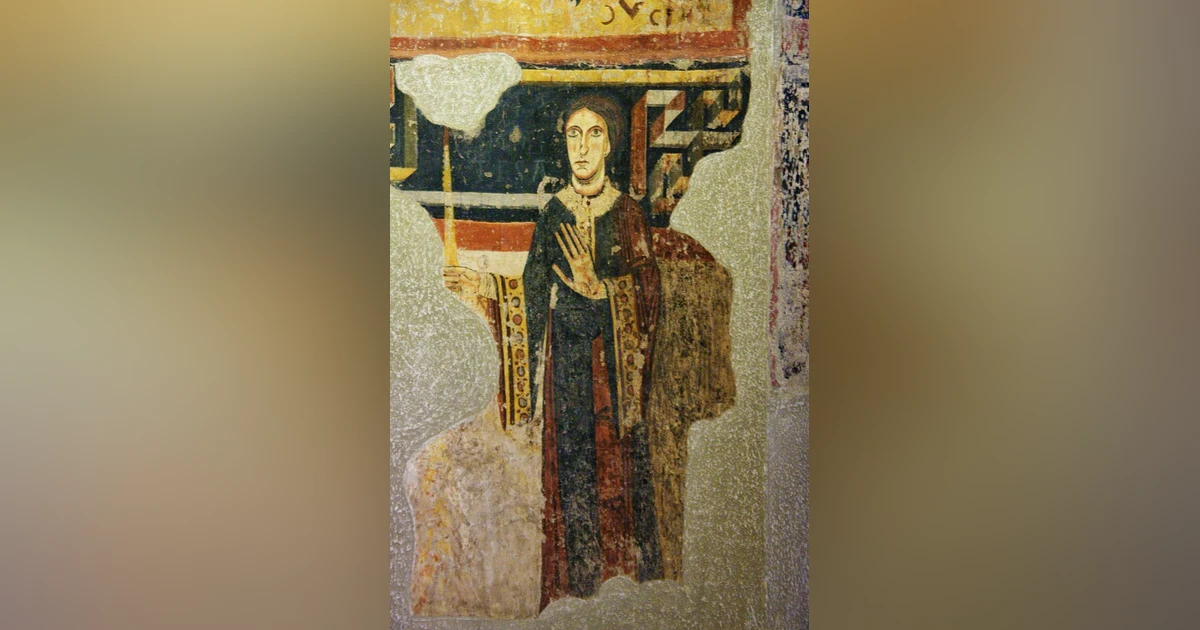


We cover a number of great ladies of medieval Occitania.
I myself will ride there,
Wearing my coat of mail, my shining helmet laced on,
Shield at my neck, sword at my side,
Lance in hand, ahead of all others,
Though my hair is grey and white,
My heart is bold and thirsts for war.
-Ermengard of Narbonne’s speech in Aliscans, 12th century chanson de geste
Ermengarda was perhaps five years old when her father died in holy war. Aimery II, Viscount of Narbonne had left his family to join the Siege of Fraga (1134) on behalf of his ally, Alfonso the Battler, King of Aragon and Navarre. Despite their numerical superiority the Christian forces were defeated and both Alfonso and Aimery II died in the struggle. Without a male heir, Ermengarda inherited her father’s title, becoming Viscountess of Narbonne.
Narbonne was at this time one of the most important territories in Occitania. It had access to ports along the Mediterranean that brought in significant wealth. It also served as an important crossroads between the County of Barcelona to the south and the heartland of Occitania to the north.
When news arrived that Aimery II was dead, Anfós Jordan, Count of Toulouse, marched on Narbonne. Half of the city supported Ermengarda as their independent ruler with the other half declaring that she should subordinate herself to the Count of Toulouse. Anfós won the political conflict and in 1134 he ruled the viscounty ostensibly on the girl’s behalf.
A whole new conflict erupted in 1142 when Ermengarda turned 12 or 13. By medieval standards she was a woman and could rule in her own right, something which the Count of Toulouse could not allow. Anfós repudiated his wife, who had borne his four children, freeing him up for new nuptials. The 39 year-old man was a bachelor again and was looking for hot singles in his area. He again led a force to Narbonne and declared his ‘love’ to Ermengarda. According to Occitan law marriage had to be consensual and unfortunately for the Count, the young woman looked at Anfós with disgust. Yet, she had no choice; the archbishop and leading political figures forced her to marry the aging count on 21 October 1142.
Their marriage was an act of war. Ramon Berenguer IV, Count of Barcelona and Provence could not allow Anfós to cut a gigantic wedge between his two territories. He also could not allow his relative to come under the power of his mortal enemy. The Count of Barcelona and Viscountess were the great-grandchildren of Robert Guiscard, the Norman mercenary who conquered southern Italy, and their families shared territories with each other across the Pyrenees. The Count of Montpellier and House Trencavel joined the war and together defeated Anfós Jordan, who they captured. In exchange for his freedom the Count of Toulouse gave up his claim to Narbonne and the marriage was dissolved.
Freed from her predatorial husband, Ermengarda set about ruling in her own right. First, she immediately married the 40-year-old Bernard of Anduze. Neither spouse had any interest in each other. The arrangement was purely a legal defense for Ermengarda against any man who would try to force her hand. Bernard was excluded from the succession of Narbonne and denied any power there. Bernard was fine with this as he already had an heir. Rather than share a honeymoon, Bernard traveled east and the husband and wife may have never seen each other again.
After marrying and immediately dismissing her new husband, Ermengarda set out on a path of revenge. Fortunately for her, she already had a hit list written up: her wedding contract included a list of official witnesses: those being all the city officials who had chosen to support her captivity. One by one each of the witnesses to her nuptials disappeared from the historical record, save only one whose family was too powerful to sideline. If Quentin Tarantino is listening and if you’ve ever wanted to direct a medieval revenge film, here is a woman whose wedding list became her hit list.
Despite her youth and many enemies, Ermengarda became one of the most powerful and respected lords in Occitania. Under her reign Narbonne competed with Montpellier for the title of ‘Richest French City on the Mediterranean.’ In some ways, Narbonne was in an even better position than its sister city; Montpellier had to compete with powerful Italian city states. In 1143 Genoa assaulted Montpellier and forced the French city to become a tributary which paid the Italians 1,000 silver marks and gave their merchants special privileges even as Montpellier’s own merchants took on new restrictions. Narbonne was too far away from Italy to easily dominate, allowing Ermengarda to play the Italians off each other. In 1166 Ermengarda secured a monopoly on pilgrim traffic from Montpellier to Provence for her city in exchange for Narbonne’s support against Pisa. When the five-year treaty expired Ermengarda switched sides to keep Genoa from becoming too powerful.
With the Italians busy fighting amongst themselves and French cities on the eastern half of the Bay of Lion, Narbonne dominated the far Western Mediterranean fielding significant trade all the way to the strait of Gibraltar. Aside from the sea, Narbonne controlled a significant stretch of the Via Domitia, the old Roman road that still served as the major highway along the coast.
Narbonne prospered under Ermengarda and the city became famous for its salt pans and its richly dyed woolen cloth. It also benefitted from a significant Jewish population with many serving as merchants and traders. According to legend, King David himself sent a rabbi to Narbonne to found a Talmudic school. Another story holds that the Jewish population of the city betrayed their Muslim rulers and opened the gates to Charlemagne. While Christians and Muslims were often on bad terms due to all those holy wars, Jews could pass between Christendom and the Ummah and served as a vital node of commerce between the two peoples. All of this trading meant that Narbonne experienced a significant housing boom during Ermengarda’s reign as people flocked to the city for employment and security. In one case a Christian man bought a home for 100 solidi and within a few years flipped it to wealthy Jews for double the price. That would be a good bargain even in our time but for a medieval economy that was an outrageous increase in wealth.
Like any medieval lord, Ermengarda faced military threats. Yet, she was up to the task. Luckily for her, she had a number of female role models who had served in similar positions. Her own grandmother Mahaut had been a war-leader. When her husband, Ramon Berenguer II of Barcelona was assassinated, Mahaut fled to Rodez and married Aimery I to protect her widow’s rights. When her husband departed for the Second Crusade she led the war effort against the archbishop of Nîmes.
At the age of 20, Ermengarda became one of the first known women war leaders in the Reconquista when she led an army in support of the Siege of Tortosa in 1148. After the siege’s conclusion she was a full partner in the negotiations. In 1153 Raymond Trencavel was captured by the Count of Toulouse. Rather than surrender his rights to a rival, Raymond put his armies under Ermengarda’s control. Later on, she joined Barcelona in its successful siege of Les Baux.
Ermengarda’s court became a center for what historians call the Renaissance of the 12th century. Physicians, lawyers, scholars and of course, troubadours, flocked to the palace. Hers became a center of courtly love and she is remembered in many songs. According to one source, the viscountess even fell in love with one famous singer, Pierre de Rougier. However, she was technically still married, even if she and her husband had lived separately for decades. To avoid scandal, she begrudgingly banished him from court.
Ermengarda survived against numerous enemies within and without her city and reigned from 1134 to 1192, an astonishingly long time. Her downfall came from within her own family when her nephew and designated heir decided he could not wait any longer for his birthright. After he usurped power Ermengarda tried to assemble a coalition to retake her viscounty but failed to garner enough support. She lived in exile in Roussillon and died four years later. Poets sang about her long after her death as far away as the Orkney Isles. For that reason her name became popular among Norse girls.
Ermengarda was a remarkable woman who ruled at a time and place where women were not considered equal to men. Despite this, she was not alone. In fact, she lived during a period where many powerful French ladies exerted their influence over the country and beyond. Mathilde, granddaughter of Guillaume le Conquérant, warred for control of England against her cousin Étienne of Blois with support from her husband, the Emperor. Aliénor of Aquitaine dominated her own territory despite her marriage to two separate kings and played a major role in French politics. Queen Marguerite of Navarre ruled the Kingdom of Sicily alongside her son during a period of constant turmoil.
Another great lady from Occitania was Maria of Montpellier. Despite being the rightful inheritor of the city, her father forced her to sign away her rights in favor of her half-brothers. When the patriarch of House Montpellier died, Maria’s twelve-year-old half-brother prepared to take the city. Yet, the citizens revolted and placed her in power. To secure her rights, she married Pedro II of Aragon. When Maria’s husband separated from her, Maria became a staunch ally of the Knights Templar in exchange for their guarantee that they would defend her children’s rights. Despite Maria’s separation from her husband, her son inherited the throne of Aragon and became Jaime I, the Conquistador. Jaime I ruled as king for 62 years, the longest in Iberian history. He became one of Aragon’s greatest kings and significantly expanded its territory. He was also a major patron of the arts. The many poets who passed through his court gave definitive shape to the Catalan language.
Another notable lady was Adélaïde of Toulouse, daughter of the Count of Toulouse and princess Constance of France. Adélaïde married Roger II Trencavel, though their relationship was always strained because she was a devout Catholic and he was a Cathar. While Roger II spent most of his time away, Adélaïde hosted a famous court of love at Burlat. There the troubadours composed songs praising her legendary beauty. As tension between Catholics and Cathars grew, Roger II took their son and raised him as a Cathar. The young Raymond Roger fought in the doomed Siege of Carcassonne and died shortly thereafter.
Tiburge was the only child of Raimbaud II, Count of Orange, who distinguished himself in the First Crusade. When he died in 1115 Tiburge became the Countess of Orange. During her tenure she greatly expanded the city, establishing three new suburbs: one at Saint-Florent, another around the Augustan Arc de Triompe and the third around the church of Saint Peter. Her two sons became famous troubadours and divided the city between them before it passed to the House of Baux.
Ermessende of Pelet was one of many powerful women who protected her house while her husband was at war. Her work was pivotal since her particular husband, Raymond VI, Count of Toulouse had many enemies. These included the Duke of Aquitaine, who claimed he was the rightful ruler of Toulouse, the House of Barcelona which also controlled Provence, and honestly most of Occitania who were just accustomed to fighting Toulouse by this point. While Raymond VI warred on multiple fronts Ermessende managed the city and worked to establish alliances for her husband.
While medieval Occitania had a male-dominated society there existed spaces for women to exercise power. Many notable women played major roles in the political and economic development of Occitania and often served as the driving force behind the flowering of southern culture.
One important question that remains to this day is: how did southern France differ from the north when it came to women’s place in society? While great women could be found everywhere, it is likely that there were more women in positions of power in Occitania than in the north.
One major difference between northern and southern law was that northern women could not inherit lands or titles while southern women could. This has led to intense debate among historians over whether Northern or Southern women exercised more power in their respective societies. One school of thought claims that because Southern women could control wealth in their own right they had far more influence in society. Scholars on the other side of the issue claim that the Southern tradition of dividing land meant that women exercised little real power, and the Northern women regents and widows of nobles had incredible real power, even if they had to do so in the name of a husband or son. As always happens in a dispute, a third school claims that it was a little of the former a little of the latter and whether a woman held more power depended on their individual situation rather than their geographic location.
Another difference between north and south that gave power to southern women was the difference in landholding arrangements. Northerners had a feudal system wherein landholders had to render military service to their lords, something which only men could do. In Occitania landholding was primarily allodial meaning landowners did not have to offer military service, opening up independent landholding to women.
Between 10 to 12% of the independent lords in Occitania were women. These women ruled estates, administered justice and held court in their own name without relying on a man for legitimacy. In contrast, Northern women could only do so on behalf of absentee husbands or as regents for their sons. Given how much power southern women possessed, it is not surprising that Occitania developed courtly love as men sought to woo independent female lords, unlike in the north where men tried to woo their father…I mean they tried to get their father to hand over- you know what I mean!
Still, women’s power declined over time. The southern practice of dividing their inheritance meant that later generations received smaller and smaller slices of land. Increasingly, lords saved the largest shares of land for their male heirs who were better able to defend it. As women’s dowries declined in value so did their independent power. Thus, women’s power was already declining in the 12th century.
Women’s rights took a huge blow with the Albigensian Crusade. When the Northerners came they imposed their values and laws on the south. More feudally-held land meant that women, who were not soldiers, could not hold land in their own right. At the same time, individual lords took control of southern lands, which they then passed on to their own sons, disinheriting southern men and women alike. Occitania was hardly a feminist paradise in its heyday, but during the 11th to 12th centuries women enjoyed significant rights and independence. Invasion from the north brought an end to this period and women’s second-class status became more firmly entrenched in southern society.
Special thanks to Bry of Pontifacts Podcast for reading out the quote. Pontifacts is a podcast that ranks every pope from Saint Peter to Pope Leo, so go check them out!
Sources:
Frederic L. Cheyette, Ermengard of Narbonne and the World of the Troubadours, 2001.
Ed. Linda Paterson, Culture and Society in Medieval Occitania, 2011.