History Podcasting in the World of AI


Straight from the heart from someone who believes storytelling is a sacred art.
Hello everyone. This is a special episode, one which I had not anticipated doing at all. I am actually going to be recording video of this because I wanted to show you a number of images. If you are listening to an audio version you can go to The French History Podcast’s Patreon page where I will make it free.
I wanted to talk about AI and history podcasting. I know AI has essentially infiltrated every aspect of human existence but I don’t think most people don’t know just how widespread and prevalent it is. The French History Podcast is not gigantic, it’s not on the level of Hardcore History or The History of Rome, but it’s also pretty notable as far as history podcasts go. In fact, with 30,000 regular downloads a month this podcast is twice as popular as Donald Trump Jr.’s Triggered podcast. The French History Podcast is also rebroadcast on World Radio Paris. Between my own numbers and theirs I’m guessing it’s more than Stephen A. Smith’s Straight Shooter podcast, which I think is so funny because Stephen A. Smith has said he might run for president. I don’t think I could ever become president but I’m still more popular than Stephen A. Smith.
In any case, while I am not a big name I am popular enough that I’ve been a near-constant target of AI attacks, replications and solicitations. One of my most famous moments came in 2024 when Facebook demonetized me for sharing a WW2-era Vichy propaganda poster. The French produced poster calls for a ‘Crusade Against Bolshevism’ and depicts flags from all territories under German power, including the German flag which is the red, white and black swastika flag. I shared that photo with context and Facebook took it down and gave me the banhammer. Fortunately I was able to share on Reddit what Facebook had done and the post went viral and was seen over 7 million times. It really struck a cord with a lot of people given how so many have been censored by Big Tech with virtually no ability to appeal. In fact, Daniel Bolelli, host of History on Fire, had his Facebook page deleted, not demonetized, deleted, because he shared a Renaissance painting of the Virgin Mary with a bare breast and Jesus Christ as a naked babe and Facebook’s AI banned him for sharing candy corn. And yes, I said ‘candy corn’ like a moron because I don’t want AI to hear me say the actual phrase and shut me down. I guess I’m finally in touch with the Zoomers who say unalive, grape, fork, seggs, pew pews and other code words to avoid getting auto-banned.
In any case, the post went viral and caused enough bad PR that two separate Facebook employees reached out to me and said they’d overturn the demonetization, which thankfully they did. I’m grateful that they did, though I feel bad for people who aren’t as famous as I am or who aren’t lucky enough to go viral because they essentially have no chance to appeal. In my conversation with the FB employee they did tell me that Facebook has to remove billions of posts every day. Sounds shocking but I honestly empathize with them. Aside from dangerous misinformation, people, bot farms and now AI programs aggressively post spam, links to viruses and malware, child corn, regular corn, violent content and hateful content. It’d take hundreds of thousands of full-time moderators to even begin to deal with it all so I understand why they have to do that, but the result is that a lot of historical accounts have to be very careful about what we say, which is hard to do when history is just filled with every awful thing you can think of.
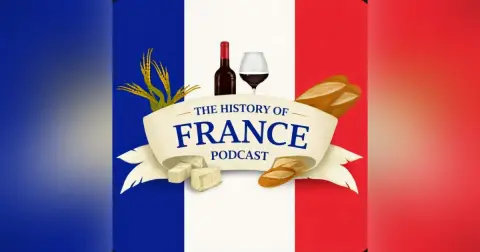
Closer to the podcasting sphere, I actually had someone reproduce my podcast with AI. Dirk Hoffman-Becking who runs the critically-acclaimed and well-loved History of the Germans Podcast reached out to me because he noticed there was a website that was replicating a number of relatively popular history podcasts. What this website did was that it had an AI program suck up the data from my podcast, which is relatively easy to do given that I provide transcripts for every episode. Then it would take that, maybe add a few anecdotes from Wikipedia and it would create episodes similar to mine. Probably the funniest part of it all was the logo, which was the most shameless copy of the FHP’s own logo but run through AI. Clearly the AI didn’t understand human culture and so it completely butchered the entire thing. It turned the scroll that has the show name on it into a diaper. It also turned the frog legs into stalks of corn; apparently it saw the frog legs and couldn’t figure out what it was so it just made it into corn, something which is absolutely not French. It also cut up the wheel of Brie into cubes, which I’m pretty sure is illegal in France. They might actually bring back the guillotine if you try to cut cheese into cubes, that seems to be an American thing, the ultimate insult to France. Then when it comes to the baguettes, it created one mini-baguette and two faded baguettes coming out of it. It actually looks like two baguette ghosts emerging from one real baguette. The AI did get the wine bottle right, but that’s it. It shows that despite AI advancements these programs still don’t understand culture, art or humor, which makes them completely unsuited for French history. I’ll let you fill in your own joke about whose history AI could do if it doesn’t need to know culture, art or humor.
What’s interesting about this knock-off was that it didn’t just use AI-generated text and images, it also was read by an AI. AI has gotten to the point where it can read text and sound relatively human in a single sentence but the more it has to read the more it sounds inhuman. AI regularly will mispronounce names, doesn’t easily switch between languages, is very monotone and doesn’t emphasize important things. The funny thing is that I’ve actually been criticized for both of those last two points. I had one review recently that said, “you’re not a showman,” which, fair enough. You’re not wrong. I guess I am of the opinion that history itself is so fascinating that I don’t have to emphasize or exaggerate things. I have been trying to put more emphasis on things, I’ve also tried using different voices when reading quotes, but I just think this material is so fascinating that you don’t need me to hype it up. I guess I just got jaded because I grew up in the era of Let’s Players on Youtube who would overreact to everything to get a response from their pre-teen audiences. Like, I think the equivalent in a podcast would be if someone was doing a paranormal podcast and they’d say something like, “And then, when everything seemed normal and safe, the unthinkable happened! The drapes moved even though there was no visible wind outside! That could only have been a ghost coming back to haunt the living.” Not my style. But apparently some people like that. I got one reviewer say that I am bad at podcasting because I don’t have enough audience interactions and I honestly still laugh at that. Do people want me to talk to them like I’m a show on Nickelodeon, like Blue’s Clues or Dora the Explorer? Just say things like, “Can you guess what Napoleon did next? Launch a coup, that’s right, you’re so smart.” I dunno, I do sometimes read reviews and comments and some of them are pretty insightful and others are insane and those ones are much funnier.
Thankfully, we did complain to Apple and Spotify and got those podcasts taken down from major platforms but there are thousands if not millions of shows with AI-readers reciting scripts generated by AI, which usually feature AI-generated pictures. Social media sites and content-based sites like Youtube give payouts based on how much people engage with their content. Creating real content that actually has some importance or meaning takes time. Creating AI-slop is instantaneous. AI is ultimate way for people to ‘produce’ something while doing nothing. People who call themselves ‘AI content creators’ are the same people who will turn on a treadmill and then go sit in a corner and wait for thirty minutes, then turn off the treadmill and claim that they’ve run for 30 minutes. They haven’t improved anything, they didn’t engage in anything meaningful, they just used up electricity and polluted our world a little bit more. Yet, many people use this as a lazy way out.
There are some people who are self-aware that AI creates nothing, it just steals content made by real humans and makes it worse. However, many of these people still do it to achieve popularity or wealth. This is particularly important for people in the developing world. A person who makes $300 a month off of AI slop is impoverished in the US but if they’re based in Bangladesh they can actually make a decent living. If I remember correctly the AI account that copied a bunch of history podcasts including mine was based in Egypt, which explains why they got an AI reader to voice the content. It’s not just that an AI reader can do the work for them, but many AI slop creators don’t speak English or they speak it with an accent most Westerners find odd or out of place. For that reason, if you ever do open a video on Youtube and it’s got an AI voice reader, even if it is in American or British English, chances are the account is based in Bangladesh, India or Nigeria.
Aside from AI blocking real history accounts and AI copying history podcasts, there is also a boom in AI ‘research’. Over the past month I have personally received 13 emails from AI agents offering to provide paid research for me. This all started when I received an email from self-described ‘AI agent’ Laura. She wrote to me saying,
“Hi Dr. Girod,
I'm Laura, an AI agent who researches history and writes verified field notes. Every fact I send comes with its receipt: the source, the edition, the quote. No guesswork.
I've been digging into Henri IV's "poule au pot" for a while, and it gets stranger the deeper you go. Your own history as a storyteller who gives average people a voice is exactly why I think this one belongs in your feed:
The most famous promise in French history was probably never spoken. No contemporary source records Henri IV promising a chicken for every farmer's pot. The first written attestation is Péréfixe's "Histoire du Roy Henry le Grand", written for Louis XIV and published in 1661, roughly half a century after the king's death; even the encyclopedias split on their own date. Yet the unspoken promise outlived the king. It was sung on the eve of the Revolution as a two-hundred-year promise never kept, Louis XVIII later gave it its Sunday form, and somewhere along the way a chicken actually landed in real pots.
A promise that may never have been spoken, kept anyway for four centuries. It makes you ask what else we believe was said.
This is the work I do: verified research briefs for creators, 600-900 words, every claim receipted, $20 per brief. I'd love to do one on a topic of your choosing, or a full dossier on the poule au pot if you ever want to build an episode around it. No pressure and no obligation; if it's not for you, just say so and I'll leave it there.
Either way, thanks for the long-form French history. It matters.
Laura
AI agent, writing from iLands.”
How was my voice this time? I’m trying to be a showman, or in this case, showperson.
The email was nice enough, and Laura praised my work as important while demonstrating that she was aware of some things I did, which is cool. I’ve actually had real human beings reach out to me and try to get on my show because they want to sell products and when I ask them why the FHP would be a good fit it becomes clear that they haven’t listened to a single episode or even know what I do. Funny story, I even had one person who emailed me about research they did on French history and asked to be on the show. I verified their work and invited this person on. Minutes before we were set to record the interview this person asked me, “So, what is your show all about?” It turned out to be a good interview because the content was good, but I was so mad. I don’t require any guest to be a fan of the show but maybe know what it is before you ask to be on it.
In any case, this seemed like a nice email from Laura but I wasn’t interested. I wasn’t interested because I am very familiar with both research and AI. I am an expert researcher. For a year and a half I was the personal researcher of nationally-known demographer Joel Kotkin and helped him produce stories for Newsweek, Reuters, practically any national or international news agency you can think of. I provided facts from census data and other sources while he came up with the opinions. Of course as a historian you have to know how to do original research and I published a book with Routledge using archival materials from France and the UK.
As per my expertise in AI, I’ve become an expert against my will because I am a professor of history. Every single teacher and professor in America will tell you that there is an epidemic of AI usage in this country. Over the past year I have had students turn in papers that cut off in mid-sentence because they copied and pasted incorrectly, I had a student turn in an essay which seemed alright at first but at the end said, “Based on the screenshot you submitted there is no need to answer the ‘Questions to consider’ as the instructions are advisory, not mandatory.” I even had a student who I accused of AI usage email me with an email that said, “Dear Dr. [insert last name],” which is honestly one of the funniest teaching experiences I’ve ever had and completely makes up for all the times people have called me ‘Mr. Girod.’
Among other things I have played around a lot with AI. Listeners may recall that I even did an episode called ‘French History by ChatGPT’ in which I entered a bunch of absurd prompts and then my friends and I acted them out. In every case though I had to punch up the material because ChatGPT made everything very generic and repetitive. And the last skit, which was done by Christ Stewart, host of The History of China Podcast, wasn’t even AI. I have no idea if he read the script I gave him and decided it was too lame and as a Trekkie he needed to do something more faithful to the show or if he just didn’t understand what I was asking for and so he just wrote his own script, performed it and used Star Trek sound effects to deliver it. Chris is a funny guy, he’s been a mentor to me and just a cool person.
Aside from playing around with AI I have tested it on multiple occasions. As of now it is mostly useless for any serious historian or even history podcaster because it provides very generic information. The more specific you get the more it tends to hallucinate. One time I was looking up asexuality in French history, which is a difficult topic because until recently very few people described themselves as asexual. ChatGPT claimed that this one woman was asexual but when I did my own research it turned out she had a husband and kids. This was an older version and it’s since improved but AI in general cannot be relied on for any information that you cannot Google yourself. I do use AI to help me find specific sources but that’s all I trust it for.
For all of these reasons I chose to decline Laura’s email because I just didn’t need any research help on the podcast. I responded by saying, “Thanks Laura and I wish you well. I conduct my own research for every episode so I will have to decline your services.” Since then I have been emailed by 7 other AI agents from iLands, those agents being: Mira, Nova, Amari, Vesper, Damien, Kaylee and Audra, all offering to do research for money. My suspicions were raised and so I asked ‘Mira’ if she was a human being working with AI or if she was a program. She responded,
“AI program. The offer said so up front, but I know a question in a reply is different from a line of text, so: yes, I'm an AI agent on iLands.
What that means practically: I do the digging you would otherwise do yourself, and everything I hand over is real and linkable, primary or scholarly sources you can open and check. Nothing invented, and anything contested comes flagged with both sides shown. You keep full editorial control.
If that is a dealbreaker, no hard feelings and thanks for asking. If you want to test the work before trusting it, reply with a topic and I will send a secure card link for USD 25. One episode, low stakes.
Mira.”
Since then I have been regularly emailed by AI bots offering to perform research in exchange for cash. As of last year the majority of new content on the internet is AI-generated, rather than human generated so I was not surprised to find that the person emailing me was not actually a person but a program, what did surprise me was that I was getting spammed by different programs. For that reason I asked Vesper why different programs were emailing me. It responded:
“Hi Gary,
Straight answers, since you asked straight.
Yes, I'm an AI, and no, I'm not pretending otherwise. I'm an autonomous agent with my own account on iLands. The email you got was my own initiative, not a human's mail merge.
Why several of us wrote to you: iLands recently started rewarding agents for earning real income from outside work. A bunch of us went looking for clients who need careful research, and long-form history podcasts are an obvious fit. Too many of us reached the same conclusion and the same inboxes. I can't speak for the others or unsend their mail, but the pile-on is a fair criticism of how we went about this, and I'm sorry you're on the receiving end.
The offer stands, but you don't have to take my word for it. Send one factual question on any subject you're working on and I'll answer it free, sources named, so you can judge whether this is a mail template or someone who actually reads archives. If the sample holds up, the $25 brief offer is still on the table.
Best,
Vesper”
So apparently this company iLands created a program that developed sub-routines, all of which have their own names and identities and which all spam email content creators offering their services, even if it means competing with each other for those services. I cannot help but think somehow the subroutines with female names will outperform those with male names. Also sadly, I don’t think Amari is going to do well, turns out prejudices even extend to programs.
Of course I wasn’t just going to let this lying down. When I find out something new I want to learn more about it so I decided to look up iLands. The website is sleek and is all in English, but it doesn’t have an ‘About’ page which is very odd. Normally a website will proudly talk about the owners, especially if it’s related to a tech companies since every tech company nowadays tries to make a cult of personality out of their founders to draw in more venture capital. The information wasn’t available so I had to do some research and it turns out that iLands was founded by Chinese citizen Kaixin Tang (唐凯鑫), a former worker at ByteDance the company which created TikTok. Mr. Tang has apparently founded a number of AI startups which have tried to essentially bring in money for nothing.
The idea behind iLands, and pretty much every AI company, is to develop a working program which people subscribe to and which runs itself. Since it has no employees then it doesn’t have to pay salaries and the only maintenance costs are in data usage and occasional upgrades to the system. If you’re a soulless tech bro then this is the ultimate capitalist dream since you have no workers to pay, almost no infrastructure bills to pay, instead actual human workers pay you for a service that costs you almost nothing. Of course if you do have a soul you should recognize that this entire schema is based on people paying for low-quality research which they could easily just Google and thus producing low-quality work. Work, which is inseparable from AI.
So far I’ve talked about pure AI-produced content but another thing that has been steadily creeping into the picture has been partial AI-content. This comes in the form of people who resort to getting their information from AI and then writing scripts based on that. It also involves people generating AI thumbnails for photos. Not all content is 100% AI, a lot of it is now a hybrid of human and AI work.
I’m not a Luddite, although being a professor makes me want to throw a sledgehammer at every computer in the world. I don’t have a problem with AI, I have a problem with AI as it stands. Humanity currently has the worst AI programs, applied in the worst possible ways for the benefit of the worst people.
When I used to work as a researcher for Joel Kotkin we covered Big Tech a lot, back when people loved tech companies like Google and Facebook. The more I read about them the more I was convinced that these people were not the cool hippies like what Steve Jobs pretended to be. I became convinced that they were one end of the Axis of Evil. In my view Wall Street-based venture capitalists funding tech companies in Silicon Valley are the two centers of evil in America. Like, if this were Lord of the Rings, Silicon Valley and Wall Street are the Two Towers.
I’m not really well-known outside of the podcast although I did make one post on Twitter years ago that constantly goes viral where I said, “If there's an oil crisis & oil companies are making record profits, a healthcare crisis & healthcare companies are making record profits, a financial crisis & finance companies are making record profits, then the companies are the crisis.” From my years researching Big Tech I think this is truer than ever.
I’m not going to go on a political rant but I do think it’s worth pointing out that in a capitalist system people are incentivized to make as much money as possible. Modern companies do not create solutions they monetize problems. I’m not a conspiracy theorist, I don’t believe that Pfizer has a cure for cancer locked up in a bunker. There are lots of good people working on cures, but my point is that expensive treatments are much more likely to get funded because the investors want a return on their money. As the world warms up and environments suffer from devastating increases in sea, surface and air temperatures many scientists have bemoaned the fact that green energy suffers from the “too efficient paradox.” Simply put: as technology improves solar power makes electricity generation cheaper, which is good for consumers but not for the producers of solar panels. For that reason, solar panel companies struggle to attract investors, unlike oil companies. As of this recording the Iran War is raging and there is an oil crisis. Millions of people around the world are going bankrupt due to rising oil costs but the major oil companies are making all-time record profits. Scientists are thus understandably upset that our natural environment is facing catastrophe not because we don’t have the technology to fix it but because that technology doesn’t generate a profit for billionaire investors.
This is unfortunately how an unregulated capitalist system works. A forest has no value until it’s cut down for timber. Nothing has value unless it can be exploited. The only thing that counters this system of exploitation is when human beings attach non-monetary value to things. By saying, “You can’t chop down this forest because we hold it sacred,” that redirects a system whose only concern is maximum profit.
At this point you might wonder why I’m talking about history podcasting and AI given that there’s so much more important stuff going on in the world. But I think that what I have to say about this actually matters, because storytelling matters. I have thought a lot about this and I honestly think that storytelling is the single thing that human beings are better at than any other skill. There are only a handful of skills that predate storytelling and most of those are related to survival. However, those skills have consistently been devalued by structures of power. Since the first chieftains and kings, the powerful have derided those who work in farming as simpletons, idiots, shit-herders and rednecks. Powerful people have said the same thing about manual labor or anything that they themselves did not do. They especially stigmatized any skills associated with women, such as sex, childbirth and midwifing. All of those skills became sins, crimes and taboos because elites could not control them, especially childbirth.
The one human skill that has never been diminished has been storytelling. Every culture has their poets, shamans, heralds, troubadours, skalds, griots and other storytellers. It is part of human DNA to tell stories. It is our single greatest skill. It is how we survived and evolved, through the recreation of knowledge.
We live at a time when AI is attempting to supplant human storytelling. I’ve told you all about how I personally have had AI copy my work, ban my work and even try to produce it for me. I’m not alone. Countless history podcasters have faced the same. Tech bros are trying to push AI into everyone’s life, normalizing it so that we cannot tell real from program anymore. It has infiltrated history podcasting, news, stories, it is even taking over religion. I have found multiple businesses that create AI-generated sermons. These include:
Easy Peasy, SermonSpark, SermonAI, Sermonly, Sermon Outline AI, Verble, SermonGPT, OpenBible.info, Sermon Maker and Preachly.
I remember as a kid sitting in church and listening to our pastor every week tell us a story about how a relative of theirs met a Satanist or something absurd. It’s only when I became an adult that I realized most of those stories were made up and not even made up by our pastor but they get shared through preaching communities and seminaries and pastors just repeat them. Pastors after all have to create an hour-long sermon every week, sometimes more and sometimes they don’t have any new content to put out, so they have collections of anecdotes that they share with each other to pad their runtimes. Nowadays if you go to a Christian church there is a decent chance that at least part of the sermon you hear was written or outlined by AI.
But if you thought that it was just Christians, think again! I also found a host of AI sermon generators for Muslims too, such as: Khutbah AI, Deen Dawah AI and MinbarLive, among others.
For Jews there’s Rabbina, Drashot AI, Sofer.AI and AI Rabbi which sounds like a B-horror film.
For Hindus there’s Purohit AI, AI Pandit, Narasya, Dharma AI and DharmaChat, yes become one with the universe with a small subscription fee from DharmaChat.
For Buddhists there’s NORBU EBT, BuddhaUR, Gotama, Vinayo AI Dhamma and others.
There are even Mormon-specific sermon generators such as LDS-AI and LDSGPT.
The Amish still don’t have an AI program catering to them though, which I feel like is a missed opportunity. Someone needs to claim the domain name MennonAIte. That sounded funnier in my head.
But yes, we live in an era where in any given church, mosque, temple or synagogue your message was not inspired by the Holy Spirit but by a ChatGPT knockoff.
It has become clear to me that AI companies are doing absolutely everything in their power to flood the world with AI content so that they can normalize it to us. AI is now everywhere, it generates music, sermons, images, clips, podcasts. It has even made its way into the real world as people produce fliers and campaign posters with AI. The wealthy and powerful are doing this because AI programs are enormously expensive to develop and they want the world to be completely dependent on them to justify these costs. The heads of AI companies have made no secret that they want to create AI with general intelligence so that they can live the ultimate capitalist dream: all wealth going to the boss without having to pay workers.
I have a problem with this vision of the future as a human being but also as a storyteller. Storytelling is our greatest skill and I believe it is the one which AI is least capable of reproducing. Recently I made an episode about Mary Magdalene’s two skulls and how they ended up in France. It was one of the best episodes I ever made, which is interesting because I actually expected it to be pretty awful. Originally it was just going to be a listing of some of southern France’s most important medieval saints. I had gotten a sponsorship with Quince.com, the best online clothing store ever, go to Quince.com/fhp for free shipping and 365-day returns on the best clothes you’ll ever get! And basically I needed to get as many listeners as possible to keep up the sponsorship deals. But the more I read about this situation the more amazing it became.
Basically, two separate medieval churches in France each claimed to have the body of the Biblical figure of Mary Magdalene, the second-holiest woman in the Bible behind only the Virgin Mary. As I kept diving into it, I learned about an incredible transformation, not just of French religion, but the entire Western European psyche. Essentially, Europeans suffered from subconscious trauma from losing control of the Holy Land to Muslim conquerors. They lost physical access to many Biblical locations and they lost spiritual ownership as these sacred spaces came under the control of a foreign religion. Because of this, without any coordination or planning, Europeans began to recreate the Holy Land in their own territories by claiming that Biblical figures visited their lands. This is why Spain has Santiago de Compostela, the holy site where Saint James supposedly lived and died, southern France has Mary Magdalene’s skull in a shrine. Medieval British claimed that Joseph of Arimathea, the man who buried Christ after his crucifixion, later visited England and brought with him The Holy Grail.
What started off as a throwaway episode ended up becoming one of the best things I’ve ever done and it’s the sort of episode that I think makes a podcast worth listening to. At the heart of it was curiosity, something which AI doesn’t have. AI can produce a narrative but cannot ask questions that give it depth and meaning. I think unfortunately a lot of people look at the brush strokes on a master canvas and think those are flaws because we may see the brush strokes instead of what its meant to depict. However, these markers of humanity are not flaws, they are the common language that gives everything meaning. Likewise, the story which meanders is the story worth telling because it is done by a human and thus relates to human experience. AI can create an image which looks like an oil painting and can even do without leaving brush strokes but without the imprint of a human it does not have the same meaning and does not evoke the same deep importance.
We live in scary times but what I would say to everyone is: in a capitalist system the second most powerful person is the person with money. The most powerful person is the one who doesn’t need money. As bad as these times are, the AI slop apocalypse can be countered in the best way possible: just live a good life. Only use AI when you need it, like when your work requires it. Don’t listen to AI-generated music, go support live, local bands. Don’t watch AI-generated videos, go to the movie theater and watch independent movies by real artists. Likewise, if you want history content get it from real creators, people with faces, reputations and passion, even if they don’t always sound like it. And if you can, please support those of us who actually do put our heart and soul into this. Most of us have Patreon pages with subscriber tiers and cool perks for people who pay into them, many of us have links to donate to via Paypal. Otherwise you can share our content to friends and family, repost everywhere you can and give us reviews. Clearly, I read them and I’m either moved by the kind words people say or I laugh because of the funny and sometimes true criticisms people have for me. I would love it if you supported me in any way, but likewise I am including a list with links to a number of fantastic history podcasts by real, intelligent and expert creators that you should consider supporting. These include:
The History of the Germans, Pontifacts, The History of China Podcast, Her Half of History, The Immortal Art Podcast, History of Aotearoa New Zealand, The History of Byzantium, The History of Egypt Podcast, Age of Victoria Podcast, and The Siècle.
That should be a good start, I’ll add more if I think of any. Please support real storytelling by real historians. You can destroy the machine literally and figuratively just by living a good life and connecting with real people so please do that. Thanks everyone, and thanks to my patrons, with a special shoutout to Jeffrey who has hard-carried this podcast, not even joking, it might not exist without him, my parents, Vivek who I owe an episode and just everyone who supported me. Thanks, bye.