95: Mary Magdalene's Skull
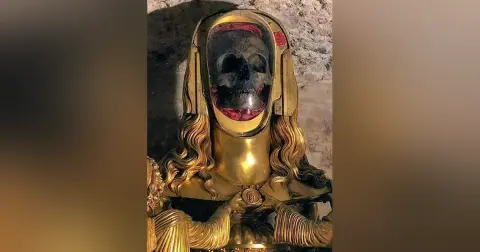


Two holy sites claim ownership of Mary Magdalene's remains. Only one skull can be the genuine bone belonging to Mary Magdalene. What follows is an epic tale of faith, fraud and the remaking of the European mind.
Chapter 1: Two Bodies for one Saint
“Sister we know that the Savior loved you more than any other woman.”
-Saint Peter to Mary Magdalene, from the Gospel of Mary, 5th century AD
“There is no abbey so poor as not to have a [piece of the True Cross]. In some places there are large fragments, as at the Holy Chapel in Paris, at Poitiers, and at Rome, where a good-sized crucifix is said to have been made of it. In brief, if all the pieces that could be found were collected together, they would make a big ship-load. Yet the Gospel testifies that a single man was able to carry it.”
-John Calvin, Treatise on Relics
This story is about the veneration of a skull and the two competing cults that sought to claim ownership of the blessed artifact. It is a story of faithful, of opportunists, of kings and popes, of peasants and monks, of religious orders and political realities. On its face, it is the story of how a Biblical saint’s remains were discovered in two separate places and venerated in both before one collection of bones beat out the other for legitimacy. What follows may seem at first like superstitious fantasy by people who stood perpetually on the brink of disaster. As we go deeper into the story we will see that this is also a window into medieval humanity’s subconscious mind as it responded to dramatic paradigm shifts across the world. Ultimately, it is a tale of despair, grief and a newfound faith which rewrote geography as southern French turned home into a new Holy Land.
Our story begins in early imperial Roman Judaea. Our main character is Mary, called Magdalene, meaning ‘from Magdala.’ According to the Synoptic Gospels of Matthew, Mark and Luke, Jesus found Mary while she was possessed by seven demons. Jesus exorcised the demons, after which Mary became one of his most important followers and preeminent of his female converts, preaching his words wherever she went and leading the other women in his retinue. In the year 591 Pope Gregory the Great amplified her story by conflating her with two other women. In a sermon, he claimed that she was the prostitute who washed Jesus’ feet with her tears and dried them with her hair. He also claimed that she was Mary the sister of Martha and of Lazarus who Jesus rose from the dead. It was only in 1969 that the Catholic Church issued a statement correcting Gregory’s interpretation and definitively stating that these three women were in fact different people. For medieval believers then, Mary Magdalene was an inspiring figure who had transformed from a demon-possessed prostitute to one of Christ’s most devoted followers.
Mary Magdalene was later present at Jesus’ crucifixion and burial. According to the Gospels she and her traveling companions were the first to discover that Jesus was no longer in his tomb and were told by a messenger, possibly an angel, that he had risen from the dead. Thereafter it is church tradition that she preached the good news for the rest of her life.
Before the rise of Islam eastern Christians venerated her and regularly made pilgrimages to sites where she lived and experienced the Messiah’s miracles. In stark contrast, Western Europeans did not venerate Mary Magdalene for a millennium. Saint veneration in France was usually reserved for the most important Biblical figures, such as Saints Paul, Peter and the Virgin Mary, and for local saints. French people wanted saints who had lived, preached, suffered and died in areas they were familiar with. Having a saint from a place you lived simultaneously made saints more relatable while making your own homeland more spiritual and important. For that reason early medieval French saint veneration was reserved for figures like Saint Hilary of Poitiers, Martin of Tours or Saturnin of Toulouse.
Mary Magdalene’s cult only became popular around the turn of the millennium. According to scholar Yossei Maurey, the first altar dedicated solely to her was in Saint-Stephen’s church in Halberstadt, Germany. In France, she gained her own feast day in the 9th century and her own church in 1049 in Verdun. After that her cult rapidly spread, with Reims, Besançon and Bayeux dedicating sacred spaces to her.
Mary Magdalene’s rise in popularity coincides with a popular 9th century legend that she spent the last years of her life in southern Gaul. Later records included an explainer, recounting that after James the Apostle was executed in Jerusalem other early Christians began to fear for their lives. The Jewish people there wanted to be rid of Christians but did not want to go so far as an execution and so they forced Mary Magdalene, her sister Martha and her brother Lazarus onto a boat (just as a reminder: the modern Catholic Church holds that Magdalene is not related to either, but many medieval Europeans believed this was the case). Alongside them were a number of other important figures such as Mary Jacobe, mother of James and the sister of the Virgin Mary, Mary Salome, mother of the apostles James and John, and the future Saint Maximin. This ship had no sails, oars or supplies and was pushed out to sea, leaving its occupants to drown or die of thirst on open waters. Rather than suffering a horrible death, the currents miraculously took these unwilling sailors to southern Gaul where they landed at Marseille. From there they brought the Gospel to the Gallo-Romans. The legend further holds that Mary Magdalene regularly took solace in the caves of Sainte-Baume until she neared the end of her life, at which point she took her last rites with Saint Maximin.
This story developed around the collapse of the Carolingian Empire and made a Biblical figure familiar to believers in France. In the year 1050 monks from the Abbey of Vézelay added a new element to this tale and claimed Mary Magdalene as their own. Before I address their twist, a word on Vézelay, a village many have probably not heard of.
Vézelay is a unique place. Located in north-central France halfway between Paris and Lyon, Vézelay is older than both. The first known settlement in Vézelay dates to the 23rd millennium BCE. For perspective, that would be around the time that Sargon of Akkad created his empire. Vézelay was uniquely suited for human habitation due to nearby collections of salt, which was used to preserve food. The village subsisted through mining salt and carried on into the Celtic era. After that the Romans conquered it and used slaves to extract as much salt as possible which they shipped along the trade route north to Lutetia (what became Paris) or south to Lugdunum (Lyon). Roman Vézelay became important enough to house a temple to Bacchus, the god of wine and opulent villas. The most prominent villa was owned by Veselius, and his land was called Veseliacum, meaning ‘Veselius’ estate,’ which became ‘Vézelay’ in French. During the reign of Charles the Bald Benedictine monks set up a monastery there. Despite the presence of a holy order, the area fell on hard times due to Norman raids. As the Carolingian Empire fell much of Europe fragmented and small villages without strong walls became perennial victims of violence.
Around the year 1050 monks of Vézelay claimed that in the 800s one of their members had taken Mary Magdalene’s bones from the church of Saint-Maximin-la-Sainte-Baume and deposited them in Vézelay Abbey. In the year 1050 the abbey was officially consecrated to Mary Magdalene and aimed to be the center of her cult. Finally, in 1058, Pope Stephen IX declared as one of his last acts before passing that the relics were the authentic bones of the saint. In short while Vézelay became one of the most important religious sites in France. To think, the second holiest of all women within the Bible itself rested in this abbey!
With spiritual authority came political power, wealth and fame. Two years after the pope’s declaration the king of France granted the village the status of a commune with its own independent governance. The monks gained incredible spiritual power and influence and the town grew wealthy and famous from the many pilgrims who passed through. In 1146 Saint Bernard of Clairvaux promoted the Second Crusade at the Council of Vézelay with King Louis VII in attendance. In 1190 the French and English armies under Philippe-Auguste and Richard Cœur de Lion met at Vézelay before leaving for the Holy Land.
Vézelay was a town on the upswing. Mary Magdalene did for Vézelay what The Beatles did for Liverpool, what Elvis did for Memphis or what Drake did for Toronto. People flocked to the town to be healed by the holy woman. Vézelay also became one stop in a pilgrimage route which included other notable holy sites. Unfortunately, Dolly Parton wouldn’t be born for another 888 years after Pope Stephen IX declared the authenticity of bones, otherwise she could have told the monks to always count their blessings more than their money. In a very short time, these men gained a reputation for corruption which ultimately proved their undoing.
Even as kings, lords and pilgrims traveled to the town to take part in miracles they came to despise Vézelay’s religious leadership. Common folk grumbled that the abbots and other high-ranking church members were fat and wealthy even as many of the peasants who worked their land were starved and impoverished. It could not have been easy for a farmer dressed in soiled rags to toil all day, catch a glimpse of the abbot in clean white linen draping his protruding belly and then go home to a daughter with sunken cheeks from too little bread and too much watery soup. At times open conflict erupted as the Benedictine order hired knights to suppress revolts by angry peasants.
The Benedictine monks were aware that they had strayed from the righteous path and were more enamored of money than holy rites. Some of them did try to change their ways. In 1207 they defrocked a particularly corrupt abbot. However, this was akin to removing one bad apple after the rest of the apples in the barrel had already begun to rot. Misuse of money was ever-present at Vézelay Abbey as was their bad reputation.
Aside from fighting with locals the monks contested with political powers. The Count of Nevers may or may not have respected the spiritual presence of Christianity’s second-holiest Mary, but he refused to cede his secular rights over the territory. To make matters even more dire the French monarchs, who had been steadily increasing their power since Philippe-Auguste destroyed the Angevin Empire, tried extending their reach southward. In 1280 the king of France Philip IV took advantage of the monks’ unpopularity, claimed that the monastery was rightfully part of his royal domain and promised to administer it better than they did. Pope Martin IV even approved of the decree, putting the monks in a desperate situation.
At this time the Benedictines of Vézelay Abbey were fiercely independent and claimed special protections due to their linkage to the powerful Cluny Abbey. This resulted in a constant struggle for prerogatives and power between monks and secular lords which caused many pilgrims to shake their heads and whisper that men of God should spend far less time on politics and moneymaking and more on religious devotion. Pilgrims became less frequent in large part because the monks rarely showcased the relics, leading many to question their authenticity.
The twilight of Vézelay Abbey occurred during the 13th century. Louis IX, known as Saint Louis, visited the abbey four times: once before embarking on the Seventh Crusade, again before leaving for the Eighth Crusade and on two other occasions. Strangely, Saint Louis IX visited another church in Provence which would later also claim to possess the bones of Mary Magdalene. In July 1254, Louis IX supplicated before God at the church of Saint-Maximin-La-Sainte-Baume, located just east of Aix-en-Provence. From humble beginnings Saint-Maximin soon came to supplant Vézelay and quickly became one of the most important holy sites in France.
Chapter Two: Moving a Spirit
“Then Mary stood up, greeted them all, and said to her brethren, Do not weep and do not grieve nor be irresolute, for His grace will be entirely with you and will protect you. But rather, let us praise His greatness, for He has prepared us and made us into Men. When Mary said this, she turned their hearts to the Good, and they began to discuss the words of the Savior.”
-The Gospel of Mary, 5th century AD
“With great veneration you revere the ashes of Paul, which I do not condemn, if your religion is consistent with your devotion. If you venerate mute and dead ashes and ignore his living image still speaking and breathing, as it were, in his writings, is not your religion utterly absurd? You worship the bones of Paul preserved in a relic casket, but do not worship the mind of Paul hidden away in his writings? You make much of a piece of his body visible through a glass covering, and you do not marvel at the whole mind of Paul shining through his writings?”
-Erasmus, The Handbook of the Christian Soldier
In the 9th century the monks of Vézelay needed to tell a story justifying how the bones of a Judean saint had made their way up to northern France. The tale they spun claimed that Mary Magdalene, Martha, Lazarus and some of Christ’s 70 or 72 disciples (the exact number depends on the source) traveled from Judea to southern Gaul, spreading the Gospel to the people of Provence. Existing chronology books and archeological records indicate that the monks of Vézelay created this story without pulling from local southern traditions. Quite the opposite; northern monks told a story and southerners heard it and thought it was wonderful to learn that so many Biblical figures came and blessed their land. In response, southerners began venerating these Scriptural characters who they now believed were part of France’s religious history.
Discontent with the monks of Vézelay combined with an increase in southern traditions set the stage for prince Charles of Salerno to remake France’s spiritual landscape. As his name suggests, Charles was a French noble ruling abroad in Italy, something which had become standard ever since the Normans invaded the southern half of the peninsula. His father was Charles I, King of Sicily, Count of Provence, King of Albania and King of Achaea. His mother was Beatrice of Provence. Charles was also the nephew of the French king Louis IX.
In 1279, Charles’ father granted him rulership of Provence while he held together the rest of his Mediterranean empire. This had been a long time coming; Charles was 25 years old and had been impatient to inherit his father’s territory. He was well into manhood by the time he gained a significant area to rule in his own right and even then this was the backwater of his father’s empire. Like any good heir-apparent, Charles desired greatness and leapt at any opportunity to claim it. Given his hunger for importance, what follows makes a lot more sense.
On 9 December 1279 prince Charles visited a Roman mausoleum east of Aix-en-Provence. There he opened up four sarcophagi, revealing the decrepit bones inside. While expecting the unbearable stench that comes from a thousand years of rot, the prince claimed that a sweet perfume exited the coffins. Despite being closed for a millennium without air or sunlight, the prince saw that a flower bloomed out of one skeleton’s mouth; a miracle if there ever was one. Charles then happily proclaimed to the world that he had found the real bones of Mary Magdalene and Saint Maximin, with Magdalene sporting a miraculous flower as a sign of her divinely-inspired preaching. The prince then produced a document which he claimed dated to 16 December 700 and was issued by a ‘King Charles’ which authenticated the bones (sidenote: we can only guess who this referred to; perhaps he meant to identify Charlemagne, though if he did he was about a century off in his counting). Five months later on 5 May 1280, Charles led an elaborate ceremony during which the bones were placed into reliquaries. The corpse assumed to be Mary Magdalene’s was divided in two. Her body was placed in a silver châsse and her skull in a golden bust with a crystal-covered opening which allowed people to view the Magdalene’s severed head.
Charles ascended to his father’s thrones in 1285, becoming Charles II of Naples. During this time Charles II contended with the Aragonese who had conquered Sicily and the Majorcans who regularly warred for control of the Western Mediterranean. In these wars Charles II was a close ally to the popes, defending their interests against the encroaching powers from Spain. The King of Naples was so tied to the popes that he even hosted the papal enclave at Castel Nuovo where Boniface VIII was elected. Boniface VIII understandably wanted to be on good terms with the Neapolitan throne, whose patriarch served as their primary defender. Thus, when Charles II pressured Boniface VIII to certify the relics in Provence, the pope could not refuse. On 3 April 1295 Boniface VIII declared that Saint-Maximin had the true bones of Mary Magdalene and gave the recently-created Dominican Order the privilege of overseeing the relics and collecting indulgences from pilgrims.
The Dominicans wasted no time legitimizing their relics. Jean Gobi the Elder released a book in 1315, the Liber miraculorum beate Marie Magdalene, which recorded 84 miracles that took place near the shrine and were attributed to Mary Magdalene. Locals claimed that she had restored sight to the blind, hearing to the deaf, healed the lame and even released prisoners from captivity. This medieval tome also made sure to bash their rivals in Vézelay by recounting a story of a failed attempt at a miracle there. Yossei Maurey recounts, “the monks of Vézelay had gifted a relic of Mary Magdalene to his monastery in Lausanne, founded in 1234 under the patronage of Mary Magdalene. One day, a man reportedly possessed by the devil arrived at his monastery so that he could be exorcised with the help of that relic. Upon being presented with the said relic by the sacristan, the devil himself profusely protested, asking the sacristan ‘Friar, what are you saying? What are you saying? Be careful of what you are saying… Clearly, friar, you have no idea what you are talking about [that is, the relic supposedly belonging to Mary Magdalene]… there is nothing here that belongs to the body or to the relics of Mary Magdalene. This is why I will not exit from this man’s body.’” Not to throw water on a 700-year-old story, but the devil is such a terrible supervillain. He’s telling people how to beat him; who does he think he is, The Riddler?
The pro-Provence propaganda had its effect. The center of Mary Magdalene’s cult moved from the north down to Provence. The Magdalene’s reliquary further became a center of a pilgrimage route that included a host of shrines to Biblical figures such as Martha who was interred in Tarascon, Lazarus in Marseille and Saint-Maximin who was numbered among the 70 or 72 disciples which Christ sent to spread the good news to all corners of the world. The English historian William of Malmesbury inadvertently added a whole new saint to the French canon when he wrote that Philip the Apostle had preached in Gaul at the end of his life. William had been trying to justify Biblical saints visiting England and wrote that if Philip the Apostle had preached in southern France then it is only reasonable to suggest other Biblical figures made their way up to jolly old England. William’s entry was based on a misunderstanding as he mistook another Philip for Philip the Apostle. However, this error was not corrected for a long time. Thus, in the process of trying to glorify England, their premier historian gave an extra saint to France.
Spiritual power blossomed in the south as Provençals could now claim that figures from Scripture had lived and died in their own land. In short order Provence attracted pilgrims from across Europe, including royalty and great artists. The legendary Italian poet Petrarch frequently visited Saint-Maximin where he venerated the relics. This experience likely influenced him to write his Sonnet 190 in which he chases a doe. In the poem, Petrarch catches up to her and finds a collar attached to her neck inscribed with the words ‘noli me tangere,’ ‘touch me not.’ This phrase was spoken by Jesus to Mary Magdalene following his resurrection. In this passage Christ uses the Magdalene to symbolically establish a gap between the earthly and spiritual realms, saying that, “blessed are those who have not seen and yet have believed.” [John 20:29].
The rise of Saint-Maximin had a devastating impact on Vézelay. In 1312 Philip IV of France seized Vézelay and its abbey, to a mixed response. The common folk accepted the change given their dislike of their Benedictine overlords. Furthermore, they were grateful that they now lived under the king’s aegis and could no longer be bullied by petty lords who dared not risk their sovereign’s wrath. In contrast, it was a dark night for the Benedictines. They had lost their saint and their independence. The town quickly transformed from the center of a major pilgrimage route to a backwater yet again. Furthermore, when Boniface VIII placed Mary Magdalene’s relics in the possession of the Dominicans he was admitting that something needed to change. The Benedictines had failed in their task to care for ‘Mary Magdalene’s’ relics; now it was time to embrace a new order, one which was far more attuned to the needs of the masses.
Chapter 3: Jerusalem in France
“When Mary had said this, she fell silent, since it was to this point that the Savior had spoken with her. But Andrew answered and said to the brethren, ‘Say what you wish to say about what she has said. I at least do not believe that the Savior said this. For certainly these teachings are strange ideas.’ Peter answered and spoke concerning these same things. He questioned them about the Savior: ‘Did He really speak privately with a woman and not openly to us? Are we to turn about and all listen to her? Did He prefer her to us?’ Then Mary wept and said to Peter, ‘My brother Peter, what do you think? Do you think that I have thought this up myself in my heart, or that I am lying about the Savior?’ Levi answered and said to Peter, ‘Peter you have always been hot tempered. Now I see you contending against the woman like the adversaries. But if the Savior made her worthy, who are you indeed to reject her? Surely the Savior knows her very well. That is why He loved her more than us. Rather let us be ashamed and put on the perfect Man, and separate as He commanded us and preach the gospel, not laying down any other rule or other law beyond what the Savior said.’ And when they heard this they began to go forth to proclaim and to preach.
-The Gospel of Mary, 5th century AD
“The Holy Land is everywhere,”
-Black Elk, 19th century Oglala Lakota medicine man
Here our story comes to an end and it is time to reflect on what it means. On the surface it seems obvious. One town in Burgundy was suffering from economic woes and its monks decided to save the town by riding a craze. They found some bones, made up a story and turned their home into a boomtown. Times were good for a while, but the Benedictines were either too greedy or too incompetent to meet the challenges that came with new wealth, power and fame. Centuries later a Mediterranean prince desperate for glory decided to establish a claim to fame and pressured the pope into declaring his set of bones genuine and those up north a fraud. By all accounts this series of events was a simple contest of power and opportunism with religion as a tool for both. Yet, there is much more to this story than this. As we read history we must remember that humans’ actions are far more the products of greater forces than of our own design, as scary a thought as that may be. We walk on roads paved for us and we delude ourselves into thinking that we are the masters of our own destiny because we chose which prepared path we went down.
To put it in less esoteric and more simple terms: American philologist Noam Chomsky once defended his claim that Americans are controlled by corporations and do not experience real choice by saying that Americans think they are free because they can choose from hundreds of different cars and dozens of colors. However, outside of a few major urban areas, they cannot choose public transit, bike paths or walkable cities. They can only choose which megacorporation to give their money to. In this manner, modern consumers can make whatever choice they want as long as their choices have no impact on overall political or economic structure, which is controlled by the elites. Similarly, comedian George Carlin said that, “Americans are meant to feel free by the exercise of meaningless choices.” He argued that when it comes to important things, people can only choose one of two political parties, purchase all their goods from a handful of major corporations and yet when Americans walk into a grocery store they believe they live in a free country because there are dozens of different kinds of bagels on the shelves…never mind the fact that nearly all of them come from the same company. Fun fact of the day: 39% of the world’s global bagel supply are currently owned by just 5 companies. Bet you didn’t expect to learn that in an episode about Mary Magdalene’s bones!
Historians refer to this dichotomy as the difference between le longue durée and catalysts, historical terms pioneered by the massively influential Annalistes school. Le longue durée is the gradual, often centuries or even millennia-long change which occurs through the actions of countless human beings. These actions are usually without oversight or direction by any particular figure and are trends which occur as humans adapt to change in their environment, innovations in technology or other outside events. Conversely, there are catalysts, sudden dramatic moments, sometimes caused by human beings, which cause a sudden change. Confusingly, these two phenomena can coexist simultaneously. Julius Caesar invaded Gaul because he was indebted to his creditors and his war was a catalyst for mass extermination of Gauls and the fall of the Roman Republic. At the same time, Gaul had been under constant and growing threat, squeezed between an expanding Rome and Germans to the east. Likewise, Rome’s fall was not caused by a single man but was a continual process over hundreds of years that saw demagogues like the Gracchi Brothers, Marius and Sulla attempt to seize ever more power for their own causes even as the senatorial class became incapable of properly governing their empire. Simply put: Caesar led a cataclysmic war between Rome and Gaul and dealt a deathblow to the Roman Republic but had he not existed these two things likely would have occurred anyway, albeit in a different form.
The creation of the cult of Mary Magdalene in Vézelay and its move to the south occurred due to a confluence of dramatic long-term changes across Western Europe during this time. These changes reveal truly fascinating and dynamic developments in France and beyond as the medieval era entered its final stages.
First, the late medieval period saw the consolidation of states under strong centralized bureaucracies and monarchies. In the 5th century the Western Roman Empire fell apart because it was too large, unwieldy and beset by invaders across its borders. In its aftermath arose countless petty states ruled by wandering warlords. Even large countries like Francia were nominally held together by a king but in reality were loose confederations of regional lords who paid homage to one great leader. Limited literacy, lack of road and bridge maintenance and the Germanic people’s inefficient or nonexistent bureaucracy inhibited state development.
By the late medieval period Western Europeans began to form powerful entities yet again. Great houses assumed overlordship of their countries. In France the Capetians struggled for legitimacy for a century until they were the undisputed monarchs. Through the spread of literacy and maintenance of roads and bridges the ruler of Paris could exert control over larger swathes of territory. Furthermore, conflict with the Angevins resulted in more highly regulated governments, particularly as the Capetians adopted Norman census-taking and accountability measures.
For the monks of Vézelay government centralization was a disaster. The King of France could boldly and without much difficulty seize what he wished, where he wished. Once their Mary Magdalene lost her legitimacy, their town was absorbed into the royal domain. In contrast, the King of Naples’ power was a huge benefit to Provence. This powerful monarch managed to recenter a major cult in his territory and even pushed the pope to consecrate it. Politics regularly interfered in the development of religion and in this case the strength of one state meant the fall of a cult center while the strength of a different state meant the birth of another.
The second major shift taking place in Europe was the decline of old religious orders in favor of new ones. The Benedictines were the oldest order in the Catholic Church, created to organize monks into companies dedicated to the austere contemplation of God. Their order dominated most of Western Europe as the Benedictines owned and administered most monasteries. This old order, like much of the church itself, had become decrepit, unresponsive to the spiritual needs of the people and corrupt from its riches. The peasantry of Vézelay had every right to be angry with the abbot, who controlled enormous wealth, largely from their labor, even as the monks failed to perform rites regularly enough to meet the needs of locals and pilgrims.
In the early 13th century two charismatic men, Saint Francis of Assisi and Dominic de Guzmán founded new orders which challenged the old. The Franciscans and Dominicans were the first mendicant orders, meaning that all those who followed the orders made a vow of poverty. In stark contrast to the earlier monastic order, the mendicant orderlies traveled widely and preached primarily to the poor. These monks were generally beloved by the people for their genuine spirit and for their dedication to uplifting those with the most need.
The rise of these new orders was part of a wide-reaching trend to purify and electrify Christianity. Many faithful viewed the Catholic Church as a stuffy, scholastic organization, corrupted by secular concerns such as wealth accumulation, landholding and involvement in politics. The mendicants challenged this system and offered an alternative which the common folk embraced with vigor.
A third and final major change relates to the geography of spirituality. This may be the most fascinating transformation of them all as it was the upwelling of a vast subconscious need, never openly expressed but which manifested all across Europe. On a subconscious level European Christians had never mentally recovered from losing the Holy Land and without thinking it, reproduced the landscape of pilgrimage and the rites associated with it in their own territories.
In 637 Muslim conquerors seized Jerusalem as part of their early conquests. The Islamic rulers were fairly tolerant towards pilgrims but regular warfare between Christian and Islamic states made travel to the Holy Land far more dangerous. In 1099 soldiers in the First Crusade retook the city, slaughtering most of those who lived there. Yet, their newfound kingdom was short-lived. Eighty-eight years later Saladin seized the city. The Crusaders only briefly regained it again in the Sixth Crusade before permanently losing it in 1244. The loss of the Holy Land was both a tragedy and a calamity for the faithful. It was a constant source of doubt for those who held that their religion was superior even as an ‘infidel’ religion dominated their holy spaces. Across Europe, spontaneously and without coordination, Christians remade the Holy Land in their own backyard.
The first and greatest of these traditions came from Spain. According to the Acts of the Apostles, James was the first ever martyr of the new Christian faith, having been beheaded by King Herod. In the 9th century Spaniards living in the mountainous northwest claimed that Saint Iago, their word for ‘James,’ had traveled to Hispania and preached the Gospel there before his return to Judaea. These Spanish Christians claimed that after his death angels placed his corpse in a rudderless ship alongside some of his still-living disciples and whisked the boat to the Iberian peninsula. The disciples then entombed Iago in the northwest where his body lay undisturbed until 814 when lights in the heavens led a hermit to the saint’s remains. Around that spot, Spaniards consecrated the land which became Santiago de Compostela, “Saint James of the Field of Stars.” In Spanish tradition Saint Iago appeared to King Ramiro and promised him victory just before the likely legendary, Battle of Clavijo. These and other miracles made Santiago de Compostela one of the holiest sites in all of Europe, and its saint eventually became the patron saint of Spain.
Santiago de Compostela was the earliest transposition of a major Biblical figure to Europe, save only Saint Peter whose relics formed the basis of the Vatican. In the great interim between the founding of Catholicism and the rise of the cult of Saint James the cults of the saints in Western Europe primarily dealt with local figures. In the immediate post-Roman world, Germanic settlers wanted to weaken the spiritual monopoly held by the official Catholic Church while local faithful venerated their own saintly deceased who they appealed to for miracles. At times these two movements converged as local lords sponsored shrines and churches to popular saints. It is during this era between the Fall of Rome and the rise of Santiago de Compostela that thousands of local saints emerged across Europe. In Gaul, later France, saints such as Genevieve of Paris, Hilary of Poitiers and Martin of Tours gave spiritual power and importance to local places. These were not a replacement for Biblical figures who stood above local saints. These were instead familiar figures who sanctified Europeans’ homeland, providing it with a measure of spirituality. Furthermore, having a local saint meant that people felt a closer emotional and spiritual connection between their own space and the afterlife by praying to someone who understood what their life was like.
During this time the Holy Land was almost as unattainable as heaven. In the minds of Europeans it was a separate space, a ‘there’ that contrasted with ‘here’ as much as ‘Paradise’ contrasted with ‘Earth.’ Journeying to the Holy Land was not simply a matter of physical relocation but spiritual elevation. For most the journey was impossible. For the wealthy, pilgrimage was feasible but still dangerous. This made it a land apart for Western Europeans, who could not travel there, or if they could, expected to be transformed.
Islamic conquest of Jerusalem shattered Christian ideas of the Holy Land. Foreign invasion meant that the Holy Land no longer belonged to Christians in both a literal sense but also a spiritual one. Much as Saint Augustine had done with the City of God, Christians incorporated this calamity into their thinking. The fall of the City of God led Christians to remake their idea of holy land as not something confined to West Asia and the Vatican but as something spread across the world. Western Europeans began to tell stories of how the greatest figures from Scripture traveled to their countries, spreading the Gospel. In this way, Western Europeans remade the Holy Land in their own countries.
After claiming Saint James as their own Spaniards also began telling stories of Saint Paul converting their ancestors to Christianity. Their evidence comes from Romans 15:24, wherein Paul states that Spain is the edge of the known world and wishes to visit there after stopping in Rome. While Paul wrote his intentions to visit Spain there are no known records that he made it there. Yet, Spaniards happily claimed that Paul had visited their land, sampled the tapas, maybe ran with a bull, and was a part of their tradition.
Likewise, numerous stories emerged from Britain about saintly figures who traveled to their island. The most famous concerned Joseph of Arimathea. The Biblical Joseph of Arimathea was a wealthy and wise man who was a quiet disciple of Jesus. Following Christ’s crucifixion he gained permission from Pilate to bury the Messiah’s body. In his 1125 book De Antiquitate Glastoniensis Ecclesiae, William of Malmesbury opens up the possibility that Joseph of Arimathea brought Christianity to Glastonbury alongside other saints. Joseph of Arimethea’s legend spread across Western Europe until it became enshrined in the Arthurian legends, ensuring its permanent place in British identity. In the late 12th and early 13th centuries, French poet Robert de Boron wrote that Joseph of Arimathea carried with him the Holy Grail, the blessed cup that Christ drank from during the Last Supper, which Joseph transported with him to Arthurian Britain. This blessed object sustained him during his travels and possessed miraculous healing powers. Later French authors built on the story, suggesting that Joseph of Arimathea or his son Josephus took the Holy Grail from Judaea to King Arthur’s Britain. The churches of England generally disregarded these more fanciful tales but did not dismiss the idea that this Biblical figure may have played a foundational role in the Christianization of Britain.
The British actually claimed quite a few apostles and other Biblical figures. One popular tradition held that the Apostle Simon the Zealot arrived in Britain during Boudica’s rebellion only to be executed by the Romans. Other figures who British Christians claimed visited their lands include: Saints Paul, Peter, Philip, James, Saint John the author of the books of John and Revelation, and Aristobulus one of the 70 or 72 saints mentioned in the book of Luke.
Then there is France. For France there was Lazarus, who Christ raised from the dead, Martha, Lazarus’ sister and fellow disciple of Jesus, Maximin one of the 70 or 72 disciples and the most important of all: Mary Magdalene. By transposing figures from Scripture into the West, Europeans made their own Holy Land. In this process they resurrected the idea of the Holy Land, which had become tarnished in their minds due to Islamic conquest and desecration of holy sites into one that remained undefiled. Furthermore, by claiming that these Biblical figures had spent time in their lands, Europeans could connect with them as they did with their own local saints.
This was part of a whole new era in the Christian faith. Christians in this era did not eliminate local saints but affirmed the importance of the hierarchy of saints with those closest to Jesus as the most important. Rather than upending or adding to the Catholic compendium of saints, believers reimagined the most important saints as figures in their own history. By transposing saints into the West Christians no longer had to choose between a lesser saint that understood their specific needs or a powerful saint who was distant from them. The Holy Land and Scripture itself was transported in the minds of Christians. The ideal ‘there’ was no longer in West Asia but ‘here’ in France, Spain and Britain. ‘There’ became much less associated with the traditional Holy Land and more with heaven itself. At the same time ‘here’ became almost, if not just as important, as Judaea.
What is fascinating about all this is that this was a continent-wide subconscious response to shared trauma. The cult of Saint James in Spain was likely not part of any great ploy to gain wealth or power. It was in all likelihood an earnest attempt to draw spiritual power from a major saint during a dire time in Spain’s history. The same can be said of many British adoptions of Biblical figures, whose stories emerged from local traditions and Arthurian legends.
This was also the case for the cult of Mary Magdalene. Don’t forget, the cult did not start in Vézelay; our earliest records indicate it started in western Germany. The Germans only venerated the figure without relating a story claiming her visitation. The adoration of Biblical saints was part of a longue durée which produced catalysts, the catalysts being each individual time someone told a new story about a saint performing miracles in their own homelands. It is likely that the monks of Vézelay consciously fabricated a story about the Magdalene’s journey to Gaul, as it is likely that Charles II of Naples did the same in the south. However, these stories and the popularity they gained were ultimately the product of a greater subconscious need on the part of Western Europeans. They had lost the Holy Land and so they made their own land holy.
Tied to all of this was a sense by many that there was something wrong with the Catholic Church as it stood. Believers struggled to reconcile their attachment to Christian principles with a leadership that seemed more concerned about wealth and power than adherence to Scripture and the needs of its people. This feeling birthed the mendicants and simultaneously the translocation of the Holy Land as Christians sought a closer connection to their faith.
On the surface, the story of Mary Magdalene’s bodily remains and the competing claims for ownership of her cult seem like a P.T. Barnum-esque con job to squeeze money out of pilgrims and desperate people searching for a miracle. However, by understanding the deeper context that these events took place in we realize that Western Europe was undergoing a fundamental, deep-rooted change which challenged existing clerical power structures and popularized religious devotion. Like the relics themselves, Mary Magdalene’s skull was not the subject of a Continent’s mental anxiety but the object upon which people reimagined spiritual possibilities.
Epilogue: Notes on a Head
“Women give themselves to God when the devil wants nothing more to do with them.”
-Sophie Arnould
The story of Saint Mary Magdalene’s relics remain important to this day. I will just recount them in brief. For decades the Dominicans faithfully guarded the relics. Unfortunately for the monks and many more innocents the competing claims of House Valois and House Plantagenet resulted in the Hundred Years’ War which devastated France. In 1357 Provence was beset by great companies of mercenaries. These masterless swordsmen rampaged across the land in the wake of the war’s chaos. For a time the Dominicans hid the reliquary in the Sainte-Baume cave where the Magdalene had spent much of her time during her legendary latter life.
Security returned to France and with it the reliquaries. Saint-Maximin regained its place as a major pilgrimage destination, visited by faithful and powerful, including king François I. In 1634, the Dominican master general Nicolas Ridolfi commissioned an extraordinary new reliquary in Rome, which Pope Urban VIII blessed on 22 July, Mary Magdalene’s feast day. His Holiness sent the new container to Provence though the relics were only reinterred in 1660 during an opulent ceremony. Louis XIV, the Sun King himself, alongside his mother Anne of Austria and a huge royal entourage, visited Saint-Maximin to host said ceremony, which occurred on 6 February. During this process the bones were examined and authenticated by Antoine Vallot, Louis XIV's personal physician. Finally, the archbishop then placed them into a new lead container, which was sealed and placed inside the urn and finally affixed with the Sun King’s seal.
During this time physicians semi-regularly examined the bones for authenticity and study. In the process many of the relics became separated. The arm bone, the saint’s hair and other pieces underwent careful inspection, meaning that the body was often not wholly together. One fragment of the saint that was especially studied was a supposed lump of skin left on the scalp. This part was dubbed the noli me tangere part. According to tradition, Christ touched Mary Magdalene’s forehead before telling her not to touch him in turn. Catholics later claimed that this stub of flesh had been preserved by the power of Christ throughout the ages. Naturally every physician wanted to study the miraculous inch of skin.
Over centuries most of the body remained intact and at least within the Kingdom of France, though each part traveled here and there intermittently. However, in 1781 Louis XVI gifted one of Mary Magdalene’s femurs to the Duke of Parma. This was before electronic gift cards had been invented, after all.
During the Revolution the French government increasingly turned against religious orders, which they viewed as pro-monarchist, superstitious and in service to foreign actors, namely the papacy. Average French citizens regularly attacked churches and shrines as symbols of backwardness and oppression. In 1793 this violence spread to Saint-Maximin. According to tradition the church’s sacristan Joseph Bastide and local faithful saved most of the relics, including the skull and the noli me tangere skin fragment, though some parts of the relics were looted or destroyed by the mob.
After subsequent governments abandoned the anti-Catholic measures of the early republic, local church leaders returned the relics to Saint-Maximan. On 12 September 1803, the Archbishop of Aix ordered an investigation of the surviving relics and their authentication. In 1860 a new reliquary was made. This one had the skull encased in a golden Madonna-style frame with a glass opening for the face. It is further surrounded by four golden angels who hold up the head.
The skull was last analyzed in 1974 by forensic scientists who concluded that it belonged to a Mediterranean woman in her 50s. Since then there have been no more investigations as the Catholic Church has prohibited further testing. The Catholic Church officially recognizes the veneration of the relics at Saint-Maximin and of Saint Mary Magdalene but has chosen not to weigh in on the historicity of the objects. The Vatican’s position appears to be that this is a divine mystery.
Special thanks to Her Half of History for reading out the quotes. If you want to check out a great new pod that talks about the other half of humanity go check them out.
Sources:
The Bible
The Catholic Encyclopedia
Clemens, Neal Raymond, Jr., “The establishment of the cult of Mary Magdalen in Provence, 1279-1543,” Columbia University ProQuest Dissertations & Theses, 1997.
Maurey, Yossi. 2024. "‘Mary Magdalene Rises from the Dust,’ Twice" Religions 15, no. 6: 659. https://doi.org/10.3390/rel15060659
Pseudo-Rabanus Maurus’ Life of Mary Magdalene and her sister Martha. https://www.magd.ox.ac.uk/blog/pseudo-rabanus-maurus-life-of-mary-magdalene-and-her-sister-martha
Francesco Petrarca, “On the Nature of Poetry To his Brother Gherardo 261-275,” https://history.hanover.edu/texts/petrarch/pet13.html
Sarah Gibbens, “Is This the Face of Mary Magdalene?” National Geographic, 12 September 2017. https://web.archive.org/web/20210301174727/https://www.nationalgeographic.com/history/article/mary-magdalene-face-skull-france-video-spd
Mordor Intelligence, “Bagel Market Size and Share,” https://www.mordorintelligence.com/industry-reports/bagel-market
William of Malmesbury, Chronicle of the Kings of England: The Anglo-Saxon Kings. https://sourcebooks.web.fordham.edu/source/malmsbury-chronicle1.asp
Wyche, Romy “A Provençal holy Land. Re-reading the Legend and the sites of Mary Magdalene in southern France,” Collegium Medievale, 2016.