96: The Troubadours Intro & Chapter 1
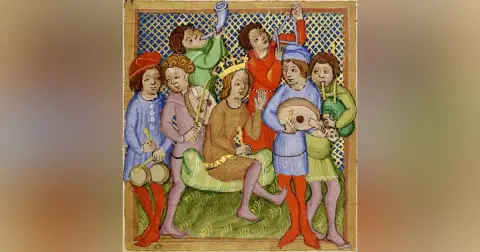


The troubadours revolutionize music, art and humanity itself. With music provided by the Unicorn Ensemble!
Domna, pos vos ay chausida by Berenguier de Palou plays (recreated by Unicorn Ensemble).
Introduction: “L’aire del temps” [Occitan for ‘Spirit of the times.’ Pronounced: "lyre del tems."]
“For when the good King Charlemagne had brought under his own dominion Provence—a land rich in wine, woods, water, and riverbanks—he gave it all away and distributed it among the jesters and minstrels, who were somewhat given to excess.” -Philippe Mouskes [quote read by Thomas Rillstone of The History of Aotearoa New Zealand Podcast]
“The French language is better suited and more beautiful for making romances and pastourelles, but that [language] of Limousin is better for making songs and cansos and sirventes.” -Dante Alighieri. [quote read by Eldin Smajlović of the Immortal Art Podcast]
Music is humanity’s most indescribable gift. Music is simultaneously our most ephemeral creation and most permanent. Once an instrument ceases to play the song ends in that moment, yet our memory and interpretation of it can last a lifetime. You may vaguely remember images you have seen and text you have read but chances are you remember perfectly songs from your childhood and are able to recite the lyrics and sing them in the correct melody and chords.
Powerful music can remake the world on multiple levels. In human history there were few musical movements that can compare with the troubadours. The late Joseph Campbell, author of such seminal works as The Hero with a Thousand Faces, once gave an interview for PBS on a show called The Power of Myth. In episode 5, “Love and Goddesses,” Campbell argued that true love itself came from the troubadours.
Campbell stated:
They're the first ones in the West that really considered love in the sense that we think of it now, as a person-to-person relationship. It's the seizure that comes in recognizing as it were your soul's counterpart in the other person, and that's what the troubadours stood for, and that has become the ideal in our lives today.
In the same interview Campbell went on to describe the different kinds of love that dominated pre-modern sentiments. One major type of love for ancient Greeks was erotic, deriving from the god Eros. Erotic love is the sensual desire for bodily pleasure, or as Campbell put ‘the organ’s desire for other organs.’ According to Greek mythology the first humans had two heads, four arms, four legs and were altogether hideous creatures until Zeus split them apart. Yet, ever since, it has been our deepest desire to reunite our body with its missing half.
The other major type of love was ‘agape.’ Agape is another Greek word that roughly translates to ‘charity.’ This form of love became the Christian ideal. It was a pious love that is beholden to ideals of goodness and upright moral conduct. To love as agape is to act in a benevolent manner without expecting anything in return.
Campbell stated that the era of the troubadours, “was one of the most important mutations of human feeling and spiritual consciousness, that a new way of experiencing love came to expression…in opposition to that ecclesiastical despotism of the heart.” During the medieval period, marriage was a political and economic contract between two individuals, often without their full consent. Parents, overlords and clerical figures decided who betrothed who. Even those who might have chosen their own marriages, such as kings, did so with a mind to how it would benefit their house. In this era pursuit of love was the absolute height of selfishness; perhaps more so.
Campbell went on to state that romantic love in the medieval era was itself a form of heresy. A marriage contract joining two people’s lives together had to be approved by the church. While churches theoretically worked with aristocrats to maintain order in society, it is not an exaggeration to say that the Catholic Church had a monopoly on relationships. The church decided who could have an emotional and sexual relationship and what form that relationship took.
Romance, as we currently understand it, is the idea that love is unbound by societal convention. Joy in being oneself with another being their true self achieves its ideal when it is freed from all constraints of religion, law, class, race, gender constructs or any other societal convention. This is what the troubadours called fin’amor, an Occitan phrase that literally means ‘fine love’ or ‘refined love,’ but which is more accurately translated as ‘true love.’ ‘True love’ is both purpose of being and the fulfillment of one’s being. Romantic love, so taken for granted today, was the ultimate act of rebellion in the medieval world. To love someone for themself and place mutual desire above the needs of one’s family was a crime against society and a sin worthy of damnation.
One thing that demonstrates how powerful and dangerous the pursuit of true love was at this time was its association with damnation. Those first peoples in medieval Christendom who chose love over duty birthed the trope of the doomed lovers. The doomed lover trope was most famously used in Romeo and Juliet by the English bard William Shakespeare. But there is an older version of this trope of defying Chistian society and even the Christian God to pursue love, that being Tristan and Isolde. Tristan and Isolde is an old tale from Wales or Ireland, but which spread across the Channel and became a commonly-told story in France. In fact, the oldest still-preserved long form versions of the story come from two French writers, Béroul and Thomas d’Angleterre, who, despite the name was likely born and raised in Normandy before moving to England.
The northern French writer Béroul built upon the story in his own version. In this version the knight Tristan is sent to escort Isolde to his uncle, King Mark, so that the two can marry. Along the way the young couple accidentally ingest a love potion. When the potion wears off the two decide to remain together, despite being in defiance of society and the church. Isolde declares, “I would rather be burned, my ashes scattered to the wind, than live so that I should have love with a man other than my lord.” In this case burning refers not only to an earthly punishment but can also refer to eternal hellfire.
Béroul was from northern France and not a troubadour himself. However, the wording of his poem reveals that his doomed lovers derived their romantic ethos from the troubadours. Near the end of the poem Tristan and Isolde are being separated by king Mark. Before their separation, Isolde gives Tristan a ring and tells him that if any messenger delivers word to her while wearing the ring she will know it is from him. She says:
But despite the prohibition of any king,
if I see the ring, I will not fail
whether it be wisdom or folly,
to do whatever he tells me
who brings me this ring,
so that it may be to our honor:
I promise you this by true love.
The last verse in its original old French reads: “Je vos promet par fine amor,” and uses the troubadour phrase for ‘true love’ as the oath that binds the two lovers together. Béroul clearly derived his concept of ‘true love’ from the troubadours, but he may have even lifted the overarching plot from them as well. Beginning with Cercamon, the troubadours wrote extensively on the story of Tristan and Isolde many decades before Béroul wrote his narrative. While Béroul’s version is one of the classic texts in the Tristan and Isolde canon, the sentiments behind his contribution to epic romance was likely already the common version among the troubadours.
The troubadours remade Western Europe and through it, the entire world. It is likely that every form of music in our current age stems from the troubadours, though in a more direct sense than one might think. So often historical events proceed like a domino effect with one action leading to another only slowly and indirectly. What is remarkable about the troubadours is how much of their work springs onto the scene fully-formed. These poet-musicians did not just lay a foundation for future artists, they built a cathedral mostly from the ground up. As we shall see, their creation of different styles have been adapted to everything from opera to rap battles.
It is not a surprise that troubadour and troubadour-inspired music dominated Western Europe for centuries. The northern French poets copied troubadour styles and made their own imitation music, becoming the trouvères. Italians kept alive troubadour traditions and adopted their styles for their own vernacular music, though even the greatest Italian writers, such as Dante Alighieri and Petrarch harkened back to the old masters from southern France. During the era of the troubadours these singers often crossed over into Iberian courts and in their wake indigenous artists responded with their own movement known as trovadorismo. In German-speaking territories troubadour music heavily influenced an already-existing movement called Minnesäng; in English, ‘love song.’
Yet, their influence is even greater than the music they left behind. According to Campbell they changed the entire psyche of Western Europeans. They defied a puritanical interpretation of the Bible which held that earthly romance was base and wicked. The troubadours boldly promoted the idea that true love was not a rejection of earthly desire in favor of abstract morality but the pursuit of desire itself. True love was what gave life meaning even if it meant death. It was poison and its own antidote, it was the wound that can only be healed by the weapon that dealt the blow.
Campbell concludes that the troubadours offered a radical reinterpretation of the Bible. When asked if love and God could be unified, Campbell replied, “Well, that's what it did do. Love was a divine visitation, and that's why it was superior to marriage. That was the troubadour idea. If God is love, well, then, love is God.”
Medieval Western Europe had been a grim place. Priests and princes declared that goodness was a rejection of desire for duty. Only by rejecting one’s hungers, needs and passions might some type of order reign. The troubadours dared to say that rejecting love was not Godliness. In fact, to love was the most godly act one could ever do.
Chapter 1: The First Troubadour
“He wallowed in every hogpool of vice, as if he thought that everything was driven by chance rather than ruled by Providence. Spicing his inanities with a certain witty elegance he turned everything into a joke and set his audience to roaring with unbridled laugher.” -William of Malmesbury on Guillaume IX, Duke of Aquitaine
“The count of Poitiers was one of the courtliest men in the world and one of the greatest deceivers or ladies. He was a fine knight at arms and generous in his wooing; and he was good at composing and singing. And he spent a long time travelling through the world in order to trick ladies.” -Orderic Vitalis [Quotes read by Dirk Hoffman of The History of the Germans podcast]
Before the troubadours poetry was written in Latin, the language of scholars and the elite. By the late 11th century there probably were rebellious poets in the lower ranks of the nobility and clergy who started composing in Occitan. Yet, at the high and noble courts, anyone writing in the vernacular was considered unserious and uncultured. It took a unique person to change the course of human history. It had to be someone who was born into enormous power, such that he was able to pursue his passions without fear of political reprisal or financial strain. He had to be a poet in his heart such that he would inspire those around him. He also had to live such a profane lifestyle that he cared nothing for conventional thinking. Finally, this person had to be exposed to many different cultures which he mixed together into something wholly new. The man in question was Guillaume IX, Duke of Aquitaine, known to history as ‘the first troubadour.’
Guillaume IX was the heir to the Duchy of Aquitaine, Gascony and Poitiers. His birthright was a larger swathe of territory than the realm ruled by the king of France, Philippe I who was largely confined to the Île-de-France. The Dukes of Aquitaine were the greatest of a number of powers that ruled southern France with virtually no regard for the king in the north. Rather than care about events around Paris, the Dukes of Aquitaine turned their attention south to Iberia.
After three hundred years of Islamic rule in Spain the tide was turning in a big way towards the Christians as the Caliphate broke apart into roughly a dozen emirates. Leon and Castille, Navarre and Aragon joined the County of Barcelona and made serious advances into Muslim territory. Aquitanian interest in Iberia began under Guillaume IX’s grandfather, Guillaume V “the Great,” who hosted Spanish lords and promoted the pilgrimage route of Santiago de Compostela. This road became one of the most traveled routes in Western Europe with serious advantages for the Dukes of Aquitaine. Pilgrims spent valuable coin along the route and the Dukes gained prestige as defenders of a sacred route.
Guillaume IX’s father, Guillaume VIII, deepened ties between Aquitaine and the Iberian kingdoms when he married his eldest daughter Agnès to Alfonso VI of Castile and his other daughter, also named Agnès to Pedro I of Aragon. In 1063, Pope Alexander II called for holy war against Muslims in Spain in an appeal that preempted the First Crusade by three decades. Duke Guillaume VIII answered the call so that he could better ingratiate himself with the Iberian nobility. Guillaume VIII had dismissed his first wife due to infertility, then divorced a second and finally took a third wife. The duke hoped that if he fought the enemies of Christ, Rome might forgive his infidelity and legitimize any future heirs he had.
In 1064 the Duke of Aquitaine assaulted the city of Barbastro alongside the Aragonese and contingents from across Western Europe. Among these were Normans, the most famous of which was Robert Crépin, who eventually served the Byzantines before betraying them and forming his own state in Anatolia. Hopelessly outnumbered, the Muslim garrison negotiated a surrender and opened their gates, upon which the Christians slaughtered all the men. Then they raped the women, taking them and their children to sell as slaves. While the Spaniards lost Barbastro within a year, Guillaume VIII did not particularly care. He had won glory and succeeded in convincing Rome to accept his marriage to his third wife and the right of their future son to inherit.
The young Guillaume IX spent his childhood in the frequent company of Iberians and their culture. Spaniards visited the ducal court in Aquitaine and the heir-apparent likely visited their courts in turn to see his sisters, cousins and in-laws. It is possible Guillaume IX even visited Santiago de Compostela and toured many Spanish cities along the way. Given the time, his intimacy with Spanish culture meant that he was also familiar with Arabic culture.
Ever since the 711 invasion of Iberia by Arabs and their Berber subjects an Afro-Arab culture permeated Spain. Arabs attempted to recreate the grand buildings and pleasure palaces of the east, most notably at Alhambra. Even after northern Christians secured their independence they retained aspects of Arabic culture. Arab intellectuals were highly regarded and welcomed across Mediterranean courts, given that they possessed a level of scientific knowledge above that of most European scholars in astronomy, mathematics, anatomy, cartography and virtually all sciences. In Aquitaine, the Romanesque churches of the time drew inspiration from Spanish Muslim architecture. These churches were likely designed by Spanish Christian architects who had intimate knowledge of Islamic society and the Arabic language. Additionally, it was during the 11th century that the game of chess first arrived in France. While originally invented in India, Europeans associated it with Arabs, in a story that is similar to Arabic numerals, which also originated in the Indian subcontinent.
Guillaume IX likely had personal connections to Arab Muslims both from his interactions in the Spanish courts and through direct ties in his home territory. One account from 1020 records that after a battle soldiers from Narbonne captured 20 Spanish Arabs who they took with them on their return journey. Another account holds that Guillaume IX’s grandfather personally took hostages with him to serve in Aquitaine. Finally, the Duke of Aquitaine may have even developed a friendship with the king of Zaragoza later on in his life. Evidence of this comes from a rock crystal vase which the king gifted him and which Guillaume IX passed down as a prized family heirloom. The two leaders likely became friends when in 1120 they joined forces to fight against the Almoravids. The king of Zaragoza did not want to submit to a rival power and the King of Aragon and Duke of Aquitaine were happy to kill Muslims and steal booty so they joined forces with the independent Islamic ruler and won a victory at Cutanda.
Guillaume IX likely spoke and read Arabic at some basic level and may have even come into contact with the great poets of Spain before the turn of the 12th century. However, love, politics and holy war forced him to join a voyage that brought him even deeper into the Arab world.
In 1095 many great lords in France left the country to launch the First Crusade. The Duke of Aquitaine chose not to fight the enemies of God but crush some of his own. Guillaume IX took advantage of the Count of Toulouse’s departure and invaded the great southern city on behalf of his wife Philippa of Toulouse. This was in clear violation of Pope Urban II’s decree forbidding the seizure of land and property from those gone on holy war. As penance for his crimes, Guillaume IX had to hand back Toulouse to the count’s heir-apparent and then join the Crusade of 1101.
The Crusade of 1101, otherwise called ‘The Crusade of the Faint-Hearted,’ followed immediately after the First Crusade. Its objectives were to free the recently-captured Bohemond and secure the new Crusader States. This holy war was a stunning failure. Kilij Arslan I, ‘The Sword-Lion’ who had suffered defeat in the First Crusade, got his revenge by outmaneuvering and utterly obliterating the new Christian forces. Guillaume IX himself barely escaped the slaughter with a handful of companions. Forsaking the war, they traveled to Jerusalem, fulfilling their vows and then went home.
As inglorious as this defeat was, this was yet another time that Guillaume IX likely strengthened his connections to the Muslim world. While the Crusader States were obviously ruled by Christians, most of the people they ruled over were Arab Muslims which meant that Guillaume IX likely developed his Arabic while on Crusade. He also likely listened to Arab poets in the great courts he visited.
The Arab connection was essential for the creation of troubadour music. While Guillaume IX could draw on a rich poetic tradition from Western Christendom, he incorporated vital elements of Arabic culture into his poetry and music.
Perhaps the most striking difference between Muslim and Christian culture at the time was that Muslims composed and sang in their vernacular language. The Prophet Muhammad spoke Arabic and the Qur’an was originally written in that language. In contrast, Europeans had vernacular languages but their legal, religious and poetic language was Latin, something which most people could not speak. Guillaume IX emulated the Arab poets by writing in his native language, which was a dialect of Occitan. He thus elevated this language, connected with broader audiences and struck an emotional chord by singing like a fellow Occitanian rather than a cloistered scholar.
Another hugely important contribution that Guillaume IX made to Western music was his creation of a secular music tradition. Before Guillaume IX, literacy was limited and those who composed were pressured to make only religious music. Guillaume IX certainly referenced Christianity in his works but a lot of his music was about chasing after loose women, finding and losing love, the joys of sex and daily life, his own martial exploits, which he greatly exaggerated, and jokes at the expense of others and himself. This innovation in the West was already common practice in Arab society. Rather than viewing this world as a ‘veil of tears,’ Arab poets commonly spoke about the joys of life and the pursuit of love, the last of which usually ended in sorrow. By adopting this style of story-telling Guillaume IX and the subsequent troubadours shifted the entire European mindset away from sole fixation on the afterlife and towards an appreciation of this one.
The rise of the troubadours also created a singer-songwriter culture. Before this era songs were primarily written for performance in churches and monasteries by orderlies. The composers of Gregorian chants were largely unknown. The singers of church music did so as just one of their many duties and it was not even their primary function. Since they sang in the vernacular and appealed to wide audiences the troubadours promoted themselves and their work to acquire pay. By making singing their entire profession their lives and careers were a statement to the value of song. Their success is proof that a new value emerged among nobles and commoners alike, namely that they also thought songs and poetry were worth supporting.
As full-time singers and composers by trade the troubadours became celebrities who performed solo or with others and sometimes incorporated other acts into their music. Many troubadours were also jongleurs who performed acrobatics, acted, juggled and performed illusions. Among other things this was an entertainment revolution as well, one which elevated amusement to a worthy pursuit enacted by the greatest artists of the time. As a duke, Guillaume IX could afford to perform and raised interest in such popular entertainment. By elevating this art form he paved the way for professional artists to follow after.
The most obvious and simplest thing that Guillaume IX took from Arab culture was the use of rhyming. As strange as it may seem to us today when virtually all songs rhyme, this did not occur naturally but rather developed over a long period. Arab artists made rhyming at the end of sentences a standard fixture of their poetry and music, which Guillaume IX adopted and which has become standard ever since.
What drove the Duke of Aquitaine to compose and perform music? Did he imagine himself as a King David-like figure who ruled a realm while creating songs? Or was it his many defeats abroad that made him prefer a life as a singer to one of war? Perhaps it was none of these: maybe Guillaume IX just had the heart of a poet from his birth. Whatever the reason he became the first troubadour whose works still remain to us, and through his fame he created a powerful tradition in southern France.
Guillaume IX created music that was amoral and did not consider daily life and love to be sin. His critics in the church labelled his actions immoral and given some of the lyrics it’s understandable why they did. He did compose a number of bawdy songs which talked about women’s tender parts and what he did with them with such vulgarity it would make a modern gangster rapper blush. In one of his songs he joked that he was going to found a nunnery comprised of the best prostitutes in his realm, something which was both crude and also heretical.
In one of the more tame poems he composed to be played in the company of his men, he compared two of his lovers to prized steeds, saying:
I have two horses, noble and good for my saddle;
good and strong in combat and valor;
but I can’t keep both because they hate each other.
If I could tame them to my desire,
I would not move my equipment anywhere else,
For I would be mounted better than any man alive.
Guillaume IX was a proud libertine. In one of his poems he laid out his opposition to the prudish morality of the church and his own view on life, saying:
What can it bring you if I cloister myself
and you do not keep me for your own?
All the joys of the world are ours
lady, if we love each other in turn.
As someone who enjoyed earthly pleasures he frequently took aim at churchmen, writing:
I have no fear that foreign Latin
will part me from my Good Neighbor
In this case ‘Good Neighbor’ referred to a mistress he was sleeping with.
The Duke of Aquitaine seemed to enjoy provoking the Catholic Church. Over the course of his life he had watched as the church underwent the Gregorian Reforms. The clergy were more professionalized, prudish and powerful, all things which irked him. Not only were these things not to his liking, but the church grew in power and increasingly policed the morals of the warrior aristocracy, of which he was a member. Like his adulterous father he believed that priests should not determine who a noble loved, whether the woman was his wife or someone else’s.
This disagreement in public morals inevitably got the duke in trouble on more than one occasion. In 1114 the Bishop of Poitiers excommunicated Guillaume IX while they were both in his church. The infuriated duke withdrew his sword and held it towards the bishop, ordering him to lift the excommunication. When the bishop bared his neck to the point, the duke sheathed his sword and said, “I don’t like you enough to send you to paradise.” Instead, he had the bishop imprisoned and the man of the cloth died in captivity the following year.
Five years later Guillaume IX was excommunicated a second time when he abducted a noblewoman named ‘Dangerosa.’ Translating from Poitevin to English, her name was literally ‘Dangerous,’ which is quite the name for a mistress. Dangerosa’s husband the Viscount of Châtellerault was outraged at his wife’s kidnapping and then thoroughly humiliated when it turned out that she had willingly let the duke take her. It seems Guillaume IX was not just a playboy but a charmer too, who was as popular with his men as he was with their wives.
However, he was less popular with his own wife. When Philippa found out that he had brought his mistress to live with them she tried to call upon the lords of Aquitaine to confront him for the indiscretion, but none dared or perhaps even desired to rebuke their lord. Philippa then asked the church to intervene. The papacy sent a legate to order Guillaume IX to dismiss Dangerosa and return to his wife. Guillaume IX snapped back at the bald man that, “Curls will grow on your pate before I part with the Viscountess.” He then had Dangerosa’s image painted on his shield saying that he wanted to bear her weight on the battlefield as she bore his weight in the bedroom. Philippa was so disgusted that she retired to a convent and died several years later.
As bombastic as he was, the Duke of Aquitaine was not just some skirt-chaser, only mostly. His colorful actions were a direct attempt to challenge the power of the church as popes claimed to have secular power in addition to spiritual authority. That he added a little flair to each encounter was just a part of his larger-than-life persona. Guillaume IX was not anti-clerical, as he patronized the church as much as any of his forebears, probably moreso as he figured large donations might appease the puritanical churchmen. Moreover, he always made sure to balance his scales. After his second excommunication Guillaume IX struck a deal with the church in 1120 whereby the excommunication would be lifted if he went to fight in the Reconquista. This agreement inadvertently led to his greatest military triumph when he participated in a major victory at the Battle of Cutanda.
Guillaume IX put on the face of a braggart around his men but he was very self-aware of his own reputation. In one of his poems he mocked his own propensity for boasting. Moreover, when he sang to a general court he could be genuinely romantic and completely unlike the brute he posed as in front of his soldiers. In one poem he sings:
Our love goes
as the branch from the hawthorn,
which stays trembling on the tree
at night, with the rain and the frost,
until the next day, when the sun spreads its rays
through the green leaves on the twigs.
I still remember a morning
when we brought an end to our war,
and she gave me such a great gift;
her love and her ring.
God let me live long enough
so that I can get my hands under her cloak!
Okay, so he was obsessed with sex, but he could at least mix it with sweetness and place such vulgar lyrics in compositions that were genuinely revolutionary for a Christian court.
Like many men Guillaume IX was at his most pensive as he neared his death. He composed one final song in which he reflected on his life and legacy while extorting his peers and vassals to treat kindly with his son and heir and not to abuse the young man. He sang,
Since I feel like singing,
I'll write a verse I grieve over:
I shall never be a vassal anymore
in Poitiers nor in Limoges
For now I shall be exiled:
in a dreadful fright, in great peril,
in war, shall I leave my son,
and his neighbours shall turn on him.
It is hard for me to abandon
the rule of Poitiers
I leave Folques of Anjou as a keeper
of the whole country and of his cousin.
If Folques of Anjou doesn't aid him
(and the king I owe my title to doesn't do likewise)
most of them will attack him,
those villainous Gascons and Angevins.
If he isn't very wise and valiant,
as soon as I have left you,
they will upturn him,
because they will see him young and defenceless.
I beg my companion for mercy:
if I ever wronged him, let him forgive me,
and let him praise lord Jesus in his throne
both in the common tongue and in his.
I lived with youth and valour,
but now they are both gone,
and I shall go to the One
by whom all sinners find peace.
I have been agreeable and gay,
but Our Lord doesn't allow it anymore;
now I can't bear the burden anymore,
so close I am to the end.
I have left all I used to love:
knighthood and pride;
and since this pleases god, I accept it wholly,
and let him keep me with him.
I endear all my friends to come to my death
and to honour me greatly
since I had and kept joy and sport
far and wide, and in my own abode.
So I leave joy and sport,
and squirrel and grey furs and sable.
Guillaume IX died on 10 February 1126 at the age of 54, having reigned as Duke of Aquitaine for around 40 years. His military and political career were mediocre. What conquests he made were minor or relatively short-lived, as with Toulouse. He failed in his first foray into the Reconquista, barely survived the crusade in Anatolia and only achieved a major victory near the end of his life.
His greatest legacy was as an artist. Guillaume IX’s travels, unique experiences and personality allowed him to compose the most beautiful music of his age. His sheer audacity stretched the boundaries of what was allowed and created space for future composers to enter. His position as a duke allowed him to transgress to a degree that no independent artist ever could. Like an even hornier King David, Guillaume IX successfully challenged the church’s attempts to regulate medieval society. While he largely failed in his political battles with the church, he succeeded in introducing a new art form that challenged medieval thinking by embracing feelings. The Duke of Aquitaine recentered people’s attention from the afterlife to the present. Rather than viewing the world as a ‘veil of tears’ meant to be suffered through, he took the Arab poets’ outlook that life could be beautiful and was meant to be celebrated. While he may have originally only intended to write some dirty songs to impress his men, he opened the door for one of the greatest art movements in human history and remade music along the way.